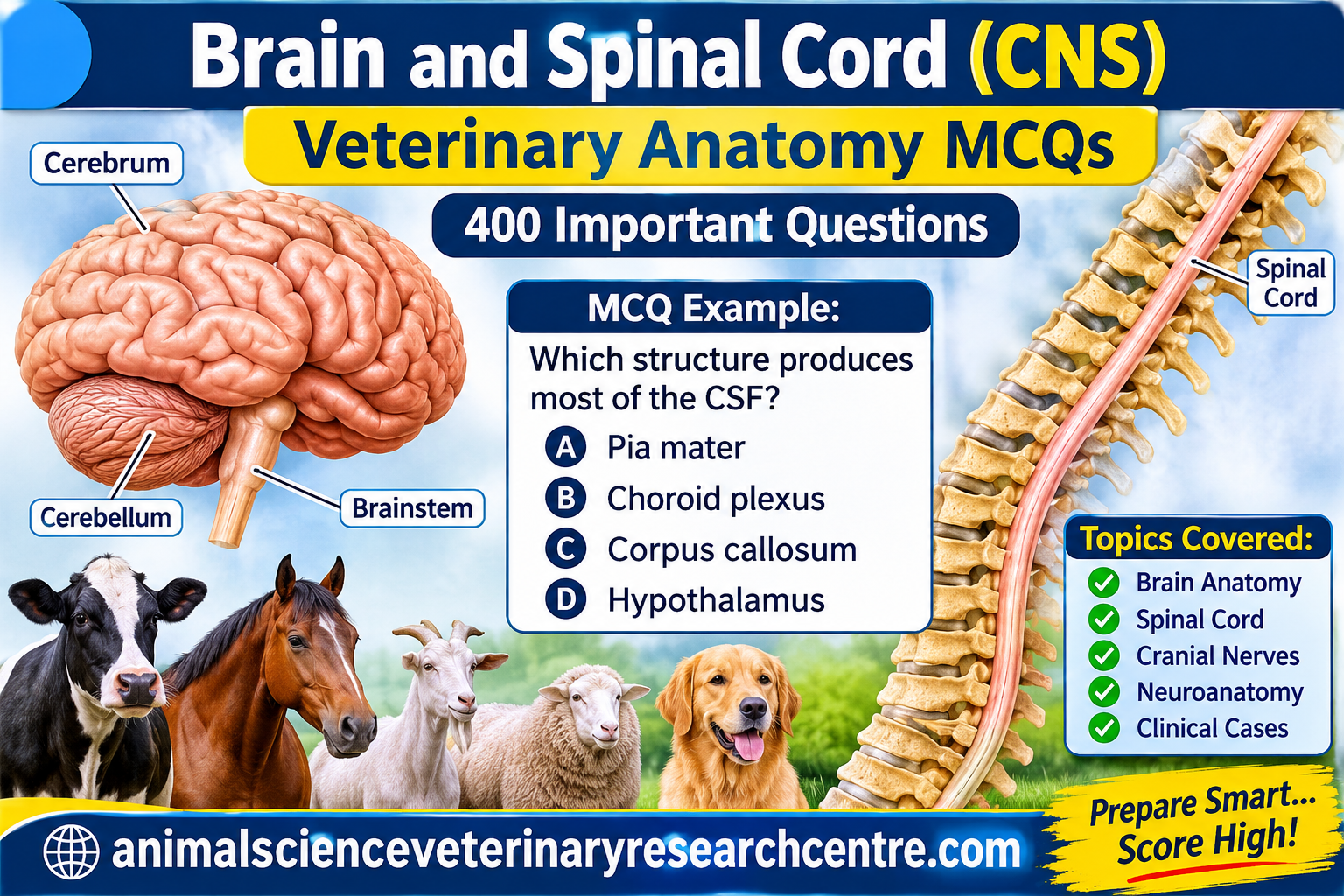


Brain and Spinal Cord (CNS): 15 Amazing Facts About Structure, Functions and Veterinary Anatomy
https://animalscienceveterinaryresearchcentre.com/brain-spinal-cord-cns
Section A: CNS का परिचय और मूल संरचना
Q1. Central Nervous System (CNS) के दो मुख्य भाग कौन-से हैं?
A. Brain और Heart
B. Brain और Spinal Cord
C. Spinal Cord और Muscles
D. Nerves और Muscles
सही उत्तर: B. Brain और Spinal Cord
व्याख्या: CNS में मस्तिष्क (Brain) और मेरुरज्जु (Spinal Cord) शामिल होते हैं। ये sensory information और motor responses के समन्वय में महत्वपूर्ण भूमिका निभाते हैं।
Q2. Brain मुख्य रूप से किस संरचना के भीतर सुरक्षित रहता है?
A. Thoracic cavity
B. Abdominal cavity
C. Cranial cavity
D. Pelvic cavity
सही उत्तर: C. Cranial cavity
व्याख्या: Brain खोपड़ी (Skull) की cranial cavity में स्थित होता है, जो इसे बाहरी चोटों से सुरक्षा प्रदान करती है।
Q3. Spinal cord मुख्य रूप से कहाँ स्थित होती है?
A. Vertebral canal
B. Thoracic cavity
C. Nasal cavity
D. Abdominal cavity
सही उत्तर: A. Vertebral canal
व्याख्या: Spinal cord कशेरुक स्तंभ (Vertebral column) के भीतर vertebral canal में स्थित होती है।
Q4. Brain और Spinal Cord को ढकने वाली झिल्लियों को क्या कहते हैं?
A. Pleura
B. Peritoneum
C. Pericardium
D. Meninges
सही उत्तर: D. Meninges
व्याख्या: Meninges तीन सुरक्षात्मक झिल्लियों—Dura mater, Arachnoid mater और Pia mater—से बनी होती हैं।
Q5. CNS का पूरा नाम क्या है?
A. Central Neural Structure
B. Central Nervous System
C. Cranial Nerve System
D. Central Neuron Structure
सही उत्तर: B. Central Nervous System
व्याख्या: CNS का अर्थ Central Nervous System है, जो शरीर के nervous system का केंद्रीय भाग है।
Q6. Brain का सबसे बड़ा प्रमुख भाग कौन-सा है?
A. Cerebellum
B. Medulla oblongata
C. Cerebrum
D. Pons
सही उत्तर: C. Cerebrum
व्याख्या: Cerebrum मस्तिष्क का सबसे बड़ा भाग है। यह sensory perception, voluntary movement, learning और memory जैसी प्रक्रियाओं में भाग लेता है।
Q7. शरीर के संतुलन और movements के coordination में कौन-सा भाग महत्वपूर्ण है?
A. Cerebellum
B. Hypothalamus
C. Thalamus
D. Pituitary gland
सही उत्तर: A. Cerebellum
व्याख्या: Cerebellum movement की precision, coordination, posture और balance बनाए रखने में सहायता करता है।
Q8. Brain और Spinal Cord के बीच प्रमुख anatomical connection कौन-सा भाग बनाता है?
A. Cerebral cortex
B. Corpus callosum
C. Cerebellar cortex
D. Brainstem
सही उत्तर: D. Brainstem
व्याख्या: Brainstem में Midbrain, Pons और Medulla oblongata शामिल हैं। यह brain और spinal cord के बीच प्रमुख connection बनाता है।
Q9. Medulla oblongata किसका भाग है?
A. Cerebrum
B. Brainstem
C. Cerebellum
D. Spinal nerve
सही उत्तर: B. Brainstem
व्याख्या: Medulla oblongata brainstem का निचला भाग है और spinal cord से जुड़ता है।
Q10. CNS और PNS में मुख्य अंतर क्या है?
A. दोनों केवल Brain से बने हैं
B. PNS में केवल muscles होते हैं
C. CNS में Brain और Spinal Cord होते हैं, जबकि PNS में इनके बाहर स्थित nerves और संबंधित संरचनाएँ शामिल होती हैं
D. CNS में केवल sensory receptors होते हैं
सही उत्तर: C. CNS में Brain और Spinal Cord होते हैं, जबकि PNS में इनके बाहर स्थित nerves और संबंधित संरचनाएँ शामिल होती हैं
व्याख्या: Peripheral Nervous System (PNS) CNS को शरीर के विभिन्न अंगों और sensory receptors से जोड़ता है।
Section B: Brain के भाग और उनके कार्य Brain and Spinal Cord (CNS): 400 Important MCQs
Q11. Cerebral cortex में मुख्य रूप से किस प्रकार का nervous tissue पाया जाता है?
A. Grey matter
B. केवल cartilage
C. केवल bone
D. Adipose tissue
सही उत्तर: A. Grey matter
व्याख्या: Cerebral cortex में neuronal cell bodies, dendrites और synapses प्रचुर मात्रा में होते हैं, जो grey matter के प्रमुख घटक हैं।
Q12. Brain में दो cerebral hemispheres को जोड़ने वाला प्रमुख bundle कौन-सा है?
A. Optic nerve
B. Medulla oblongata
C. Spinal nerve
D. Corpus callosum
सही उत्तर: D. Corpus callosum
व्याख्या: Corpus callosum अनेक nerve fibres का bundle है, जो दोनों cerebral hemispheres के बीच communication में सहायता करता है। इसका विकास और संगठन species के अनुसार भिन्न हो सकता है।
Q13. शरीर के तापमान, भूख और प्यास के नियमन में कौन-सा भाग महत्वपूर्ण है?
A. Cerebellum
B. Hypothalamus
C. Occipital lobe
D. Pons
सही उत्तर: B. Hypothalamus
व्याख्या: Hypothalamus homeostasis बनाए रखने में महत्वपूर्ण भूमिका निभाता है तथा autonomic और endocrine functions के समन्वय में भाग लेता है।
Q14. अधिकांश sensory information को cerebral cortex तक पहुँचाने में कौन-सा भाग महत्वपूर्ण relay का काम करता है?
A. Cerebellum
B. Spinal nerve
C. Thalamus
D. Pia mater
सही उत्तर: C. Thalamus
व्याख्या: Thalamus अनेक sensory pathways का प्रमुख relay centre है। Olfactory pathway का संगठन इससे कुछ अलग होता है।
Q15. Visual information के प्रसंस्करण के लिए मुख्य रूप से कौन-सा cerebral lobe जिम्मेदार है?
A. Occipital lobe
B. Frontal lobe
C. Parietal lobe
D. Temporal lobe
सही उत्तर: A. Occipital lobe
व्याख्या: Occipital lobe में visual processing से संबंधित प्रमुख cortical areas होते हैं।
Q16. Auditory processing से संबंधित प्रमुख cortical areas किस lobe में पाए जाते हैं?
A. Occipital lobe
B. Frontal lobe
C. Parietal lobe
D. Temporal lobe
सही उत्तर: D. Temporal lobe
व्याख्या: Temporal lobe में auditory processing से संबंधित cortical areas होते हैं। यह अन्य neural functions में भी भाग लेता है।
Q17. शरीर से आने वाली somatosensory information के cortical processing में कौन-सा lobe महत्वपूर्ण है?
A. Occipital lobe
B. Parietal lobe
C. Temporal lobe
D. केवल cerebellum
सही उत्तर: B. Parietal lobe
व्याख्या: Parietal lobe में somatosensory cortex स्थित होता है, जो touch, proprioception और संबंधित sensory signals के प्रसंस्करण में भाग लेता है।
Q18. Voluntary motor control से संबंधित प्रमुख cortical area सामान्यतः कहाँ पाया जाता है?
A. Occipital lobe
B. Pia mater
C. Frontal lobe
D. Arachnoid mater
सही उत्तर: C. Frontal lobe
व्याख्या: Frontal lobe में primary motor cortex और अन्य motor-related regions होते हैं, जो स्वैच्छिक गतिविधियों को नियंत्रित करने में भाग लेते हैं।
Q19. Cerebellum की चोट से कौन-सा लक्षण दिखाई दे सकता है?
A. Ataxia
B. केवल jaundice
C. केवल anaemia
D. केवल diarrhoea
सही उत्तर: A. Ataxia
व्याख्या: Ataxia में movement coordination बिगड़ जाता है। Cerebellar dysfunction इसका एक कारण है, लेकिन spinal cord और vestibular system के रोग भी ataxia पैदा कर सकते हैं।
Q20. Brainstem में कौन-सा समूह शामिल है?
A. Cerebrum, thalamus और hypothalamus
B. Frontal, parietal और temporal lobes
C. Dura mater, arachnoid और pia mater
D. Midbrain, Pons और Medulla oblongata
सही उत्तर: D. Midbrain, Pons और Medulla oblongata
व्याख्या: ये तीन संरचनाएँ brainstem बनाती हैं और neural pathways तथा कई महत्वपूर्ण physiological functions में भाग लेती हैं।
Section C: Spinal Cord की Anatomy Brain and Spinal Cord (CNS): 400 Important MCQs
Q21. Spinal cord का मुख्य कार्य क्या है?
A. केवल भोजन का पाचन
B. Brain और शरीर के बीच neural signals का संचालन तथा reflexes में भागीदारी
C. केवल bile का निर्माण
D. केवल लाल रक्त कोशिकाओं का निर्माण
सही उत्तर: B. Brain और शरीर के बीच neural signals का संचालन तथा reflexes में भागीदारी
व्याख्या: Spinal cord ascending sensory pathways, descending motor pathways और कई reflex circuits का महत्वपूर्ण केंद्र है।
Q22. Spinal nerve की dorsal root मुख्य रूप से किस प्रकार के fibres को spinal cord तक लाती है?
A. केवल motor fibres
B. केवल cardiac muscle fibres
C. Sensory fibres
D. केवल glandular tissue
सही उत्तर: C. Sensory fibres
व्याख्या: Dorsal root sensory information को spinal cord तक पहुँचाती है। Sensory neuron के cell bodies सामान्यतः dorsal root ganglion में होते हैं।
Q23. Spinal nerve की ventral root मुख्य रूप से क्या लेकर जाती है?
A. Motor fibres
B. केवल visual signals
C. केवल auditory signals
D. केवल CSF
सही उत्तर: A. Motor fibres
व्याख्या: Ventral root में मुख्य रूप से motor axons होते हैं, जो spinal cord से बाहर निकलते हैं।
Q24. Dorsal root ganglion में मुख्य रूप से किसके cell bodies पाए जाते हैं?
A. Skeletal muscle cells
B. Red blood cells
C. Hepatocytes
D. Sensory neurons
सही उत्तर: D. Sensory neurons
व्याख्या: Dorsal root ganglion में sensory neurons के cell bodies पाए जाते हैं, जो peripheral receptors से information CNS तक पहुँचाते हैं।
Q25. Spinal cord के cross-section में grey matter सामान्यतः कहाँ स्थित होता है?
A. केवल vertebral body में
B. केंद्रीय भाग में
C. केवल त्वचा में
D. केवल dorsal root ganglion में
सही उत्तर: B. केंद्रीय भाग में
व्याख्या: Spinal cord में grey matter सामान्यतः अंदर की ओर H या butterfly जैसी आकृति बनाता है, जिसके चारों ओर white matter होता है।
Q26. Spinal cord के white matter में मुख्य रूप से क्या पाया जाता है?
A. केवल adipocytes
B. केवल cartilage
C. Axons के bundles
D. केवल bone cells
सही उत्तर: C. Axons के bundles
व्याख्या: White matter में अनेक axons के bundles होते हैं, जिनमें myelinated axons प्रमुख घटक हैं।
Q27. Spinal cord में ascending pathways का सामान्य कार्य क्या है?
A. Sensory information को brain की ओर ले जाना
B. भोजन को stomach तक ले जाना
C. रक्त को हृदय तक पहुँचाना
D. केवल hormones बनाना
सही उत्तर: A. Sensory information को brain की ओर ले जाना
व्याख्या: Ascending tracts शरीर से प्राप्त sensory signals को spinal cord से ऊपर brain के विभिन्न भागों तक पहुँचाते हैं।
Q28. Descending pathways सामान्यतः किस कार्य में सहायता करते हैं?
A. केवल digestion
B. केवल urine formation
C. केवल CSF production
D. Brain से spinal cord की ओर motor तथा अन्य neural commands पहुँचाना
सही उत्तर: D. Brain से spinal cord की ओर motor तथा अन्य neural commands पहुँचाना
व्याख्या: Descending tracts movement और अन्य तंत्रिका क्रियाओं के नियंत्रण में योगदान देते हैं।
Q29. Spinal cord में reflex integration का एक उदाहरण कौन-सा है?
A. दूध का निर्माण
B. Limb withdrawal reflex
C. पित्त का स्राव
D. लाल रक्त कोशिकाओं का निर्माण
सही उत्तर: B. Limb withdrawal reflex
व्याख्या: दर्दनाक उत्तेजना पर अंग हटाने की प्रतिक्रिया में spinal reflex circuits भाग ले सकते हैं, जिससे प्रतिक्रिया तेजी से उत्पन्न होती है।
Q30. Spinal cord injury का संभावित परिणाम क्या हो सकता है?
A. केवल बालों का रंग बदलना
B. केवल horn growth बढ़ना
C. Paresis या paralysis
D. केवल दूध का रंग बदलना
सही उत्तर: C. Paresis या paralysis
व्याख्या: Spinal cord के motor pathways क्षतिग्रस्त होने पर कमजोरी या paralysis हो सकता है। लक्षण चोट के स्थान और गंभीरता पर निर्भर करते हैं।
Section D: Neurons, Neuroglia और Meninges
Q31. Nervous system की प्रमुख signaling cell कौन-सी है?
A. Neuron
B. Osteocyte
C. Chondrocyte
D. Erythrocyte
सही उत्तर: A. Neuron
व्याख्या: Neurons electrical और chemical signals के माध्यम से information का संचार करते हैं।
Q32. Neuron का कौन-सा भाग सामान्यतः signals प्राप्त करता है?
A. Tendon
B. Myelin sheath
C. Bone matrix
D. Dendrites
सही उत्तर: D. Dendrites
व्याख्या: Dendrites सामान्यतः अन्य neurons से signals प्राप्त करते हैं और उन्हें cell body की ओर पहुँचाने में सहायता करते हैं।
Q33. Neuron का कौन-सा भाग signal को cell body से दूर ले जाता है?
A. Nucleus
B. Axon
C. Dendritic spine
D. Cell membrane only
सही उत्तर: B. Axon
व्याख्या: Axon action potential को cell body से दूर अन्य neurons या target cells की ओर संचालित कर सकता है।
Q34. CNS में myelin sheath बनाने वाली कोशिकाएँ कौन-सी हैं?
A. Schwann cells
B. Ependymal cells
C. Oligodendrocytes
D. Red blood cells
सही उत्तर: C. Oligodendrocytes
व्याख्या: Oligodendrocytes CNS में myelin बनाते हैं। Peripheral nervous system में Schwann cells myelin formation करती हैं।
Q35. Peripheral Nervous System में myelin बनाने वाली प्रमुख कोशिकाएँ कौन-सी हैं?
A. Schwann cells
B. Astrocytes
C. Microglia
D. Oligodendrocytes
सही उत्तर: A. Schwann cells
व्याख्या: Schwann cells peripheral nerves के axons को myelin sheath प्रदान करती हैं और nerve function में सहायता करती हैं।
Q36. CNS की resident immune-related cells कौन-सी हैं?
A. Osteoblasts
B. Chondroblasts
C. Myocytes
D. Microglia
सही उत्तर: D. Microglia
व्याख्या: Microglia CNS की resident immune-related cells हैं। ये tissue surveillance और immune responses में भाग लेती हैं।
Q37. Brain और Spinal Cord की सबसे बाहरी meningeal layer कौन-सी है?
A. Pia mater
B. Dura mater
C. Arachnoid mater
D. Ependyma
सही उत्तर: B. Dura mater
व्याख्या: Dura mater सबसे बाहरी, मजबूत meningeal layer है। इसके नीचे arachnoid mater और फिर pia mater होती है।
Q38. Meninges की सबसे भीतरी layer कौन-सी है?
A. Dura mater
B. Arachnoid mater
C. Pia mater
D. Periosteum
सही उत्तर: C. Pia mater
व्याख्या: Pia mater brain और spinal cord की सतह के निकट रहती है तथा उनकी बाहरी सतह का अनुसरण करती है।
Q39. Cerebrospinal fluid (CSF) मुख्य रूप से कहाँ बनता है?
A. Choroid plexuses
B. Skeletal muscles
C. Liver lobules
D. Bone marrow
सही उत्तर: A. Choroid plexuses
व्याख्या: CSF का निर्माण मुख्यतः brain ventricles में स्थित choroid plexuses में होता है।
Q40. Subarachnoid space में सामान्यतः कौन-सा द्रव पाया जाता है?
A. Bile
B. Synovial fluid
C. Lymph only
D. Cerebrospinal fluid
सही उत्तर: D. Cerebrospinal fluid
व्याख्या: Subarachnoid space arachnoid mater और pia mater के बीच स्थित होता है और इसमें CSF मौजूद रहता है।
Section E: CNS Physiology और Veterinary Clinical Anatomy Brain and Spinal Cord (CNS): 400 Important MCQs
Q41. Reflex arc में stimulus को पहचानने वाला घटक कौन-सा है?
A. Effector muscle
B. Receptor
C. Motor neuron
D. Tendon only
सही उत्तर: B. Receptor
व्याख्या: Receptor stimulus को पहचानकर उसे neural signal में बदलता है, जिसे sensory pathway CNS तक ले जा सकती है।
Q42. Reflex arc में response उत्पन्न करने वाला अंतिम घटक सामान्यतः कौन-सा है?
A. Receptor
B. Sensory neuron
C. Effector
D. Dorsal root ganglion
सही उत्तर: C. Effector
व्याख्या: Effector सामान्यतः muscle या gland होता है, जो motor signal प्राप्त करने पर प्रतिक्रिया उत्पन्न करता है।
Q43. शरीर की internal conditions को स्थिर रखने की प्रक्रिया क्या कहलाती है?
A. Homeostasis
B. Ossification
C. Keratinization
D. Coagulation
सही उत्तर: A. Homeostasis
व्याख्या: Homeostasis में शरीर तापमान, पानी के संतुलन और अन्य physiological variables को उचित सीमा में बनाए रखने का प्रयास करता है।
Q44. Brain और Spinal Cord का अध्ययन पशु चिकित्सा में क्यों महत्वपूर्ण है?
A. केवल wool colour निर्धारित करने के लिए
B. केवल milk fat मापने के लिए
C. केवल horn shape पहचानने के लिए
D. Neurological examination और रोगों के संभावित स्थान को समझने के लिए
सही उत्तर: D. Neurological examination और रोगों के संभावित स्थान को समझने के लिए
व्याख्या: CNS anatomy की जानकारी से veterinarian gait abnormalities, weakness, reflex changes और अन्य neurological signs का मूल्यांकन कर सकता है।
Q45. Ataxia का सामान्य अर्थ क्या है?
A. शरीर में अत्यधिक fat जमा होना
B. Movement coordination में कमी
C. रक्त में glucose का बढ़ना
D. केवल शरीर का तापमान बढ़ना
सही उत्तर: B. Movement coordination में कमी
व्याख्या: Ataxia में चाल और अंगों की गतिविधियों का समन्वय बिगड़ जाता है। इसके कई neurological कारण हो सकते हैं।
Q46. Encephalitis किसे कहते हैं?
A. Kidney की inflammation
B. Heart की inflammation
C. Brain tissue की inflammation
D. केवल joint की inflammation
सही उत्तर: C. Brain tissue की inflammation
व्याख्या: Encephalitis में brain tissue में inflammation होती है। कारणों में कुछ infections और non-infectious conditions शामिल हैं।
Q47. Meningitis किस संरचना की inflammation है?
A. Meninges
B. Skeletal muscles
C. Liver capsule only
D. Articular cartilage
सही उत्तर: A. Meninges
व्याख्या: Meningitis brain और spinal cord को घेरने वाली meninges की inflammation है।
Q48. Veterinary neurological examination में कौन-सा मूल्यांकन उपयोगी है?
A. केवल coat colour
B. केवल horn length
C. केवल body weight
D. Gait, posture, reflexes और cranial nerve functions
सही उत्तर: D. Gait, posture, reflexes और cranial nerve functions
व्याख्या: इन findings को साथ में देखकर veterinarian संभावित neurological lesion के स्थान और प्रकृति का अनुमान लगा सकता है।
Q49. Rabies मुख्य रूप से किस system को प्रभावित करने वाला गंभीर रोग है?
A. केवल skeletal system
B. Nervous system
C. केवल digestive system
D. केवल integumentary system
सही उत्तर: B. Nervous system
व्याख्या: Rabies एक गंभीर viral disease है जो स्तनधारियों के nervous system को प्रभावित करती है। संदेह होने पर पशु को स्वयं पकड़ने के बजाय तुरंत veterinary और public-health अधिकारियों से संपर्क करना चाहिए।
Q50. CNS का सही anatomical description कौन-सा है?
A. केवल peripheral nerves
B. केवल autonomic ganglia
C. Brain और Spinal Cord
D. केवल sensory receptors
सही उत्तर: C. Brain और Spinal Cord
व्याख्या: Brain और Spinal Cord CNS के दो मुख्य भाग हैं। ये शरीर की sensory, motor और अनेक regulatory activities के समन्वय में योगदान देते हैं।
Section A: Cerebrum की संरचना (Q51–60) Brain and Spinal Cord (CNS): 400 Important MCQs
Q51. Cerebrum मुख्य रूप से किस embryonic brain division से विकसित होता है?
A. Myelencephalon
B. Telencephalon
C. Metencephalon
D. Mesencephalon
सही उत्तर: B. Telencephalon
व्याख्या: Telencephalon से cerebral hemispheres, cerebral cortex और basal nuclei जैसी संरचनाएँ विकसित होती हैं।
Q52. Cerebral hemispheres की संख्या कितनी होती है?
A. एक
B. तीन
C. दो
D. चार
सही उत्तर: C. दो
व्याख्या: Cerebrum में right और left cerebral hemispheres होते हैं, जो अनेक neural pathways के माध्यम से एक-दूसरे से जुड़े रहते हैं।
Q53. Cerebral hemispheres की बाहरी परत को क्या कहते हैं?
A. Cerebral cortex
B. Thalamus
C. Medulla oblongata
D. Ependyma
सही उत्तर: A. Cerebral cortex
व्याख्या: Cerebral cortex मुख्यतः grey matter से बनी बाहरी परत है, जिसमें neuronal cell bodies, dendrites और synapses पाए जाते हैं।
Q54. Cerebral cortex की सतह पर बनी उभरी हुई folds को क्या कहते हैं?
A. Sulci
B. Ventricles
C. Fissures only
D. Gyri
सही उत्तर: D. Gyri
व्याख्या: Gyri cerebral cortex की उभरी हुई folds हैं। ये cortical surface area बढ़ाने में सहायता करती हैं।
Q55. Cerebral cortex की दो gyri के बीच की खाँच को क्या कहते हैं?
A. Nucleus
B. Sulcus
C. Ganglion
D. Plexus
सही उत्तर: B. Sulcus
व्याख्या: Sulcus cerebral cortex की सतह पर स्थित groove या खाँच है। गहरी खाँचों को fissures भी कहा जा सकता है।
Q56. Cerebrum के दोनों hemispheres के बीच स्थित प्रमुख longitudinal groove कौन-सा है?
A. Lateral sulcus
B. Central sulcus
C. Longitudinal cerebral fissure
D. Coronary sulcus
सही उत्तर: C. Longitudinal cerebral fissure
व्याख्या: Longitudinal cerebral fissure right और left cerebral hemispheres को अलग करती है।
Q57. Cerebral cortex के नीचे स्थित white matter का मुख्य घटक क्या है?
A. Axons के bundles
B. Cartilage
C. Bone cells
D. केवल neuronal cell bodies
सही उत्तर: A. Axons के bundles
व्याख्या: Cerebral white matter में अनेक axons होते हैं, जो cortical क्षेत्रों और brain की दूसरी संरचनाओं के बीच संदेश पहुँचाते हैं।
Q58. Corpus callosum किस प्रकार के nerve fibre bundle का उदाहरण है?
A. Projection fibres
B. Peripheral sensory fibres
C. Motor end plates
D. Commissural fibres
सही उत्तर: D. Commissural fibres
व्याख्या: Commissural fibres दोनों cerebral hemispheres के संबंधित क्षेत्रों के बीच communication स्थापित करते हैं। Corpus callosum इसका प्रमुख उदाहरण है, विशेषकर मनुष्यों और कई placental mammals में।
Q59. Cerebral cortex की मोटर गतिविधियों से संबंधित प्रमुख परतों में कौन-सी परत महत्वपूर्ण है?
A. केवल pia mater
B. Layer V (internal pyramidal layer)
C. केवल arachnoid mater
D. केवल ventricular ependyma
सही उत्तर: B. Layer V (internal pyramidal layer)
व्याख्या: कई motor cortical क्षेत्रों में Layer V के pyramidal neurons महत्वपूर्ण output प्रदान करते हैं। कुछ बड़े pyramidal neurons corticospinal और अन्य descending pathways में योगदान देते हैं।
Q60. Cerebral cortex में neuronal cell bodies की अधिकता के कारण इसे सामान्यतः क्या कहा जाता है?
A. White matter
B. Fibrous capsule
C. Grey matter
D. Compact bone
सही उत्तर: C. Grey matter
व्याख्या: Cerebral cortex grey matter का भाग है। इसके नीचे मुख्य रूप से white matter pathways होते हैं।
Section B: Cerebral Lobes और उनके कार्य (Q61–70) Brain and Spinal Cord (CNS): 400 Important MCQs
Q61. Primary motor cortex सामान्यतः किस gyrus में स्थित होता है?
A. Precentral gyrus
B. Postcentral gyrus
C. Cingulate gyrus only
D. Fusiform gyrus
सही उत्तर: A. Precentral gyrus
व्याख्या: मानव मस्तिष्क में primary motor cortex frontal lobe के precentral gyrus में स्थित होता है। पशुओं में भी homologous motor cortical areas होते हैं, लेकिन उनके संगठन में प्रजाति के अनुसार अंतर होता है।
Q62. Primary somatosensory cortex सामान्यतः किस gyrus में स्थित होता है?
A. Precentral gyrus
B. Superior temporal gyrus
C. Lingual gyrus
D. Postcentral gyrus
सही उत्तर: D. Postcentral gyrus
व्याख्या: मानव मस्तिष्क में postcentral gyrus primary somatosensory cortex का प्रमुख स्थान है, जो touch, proprioception और अन्य somatic sensations के प्रसंस्करण में भाग लेता है।
Q63. Visual cortex मुख्य रूप से किस lobe में स्थित होता है?
A. Frontal lobe
B. Occipital lobe
C. Temporal lobe
D. Insular cortex only
सही उत्तर: B. Occipital lobe
व्याख्या: Occipital lobe में visual information के प्रसंस्करण से संबंधित प्रमुख cortical areas होते हैं।
Q64. Auditory cortex मुख्य रूप से किस lobe से संबंधित है?
A. Occipital lobe
B. Frontal lobe
C. Temporal lobe
D. Parietal lobe only
सही उत्तर: C. Temporal lobe
व्याख्या: Temporal lobe में auditory processing से संबंधित cortical areas पाए जाते हैं।
Q65. Frontal lobe का प्रमुख कार्य कौन-सा है?
A. Motor control और कई उच्च तंत्रिका कार्यों में भागीदारी
B. CSF का पूरा निर्माण
C. रक्त कोशिकाओं का निर्माण
D. केवल visual reception
सही उत्तर: A. Motor control और कई उच्च तंत्रिका कार्यों में भागीदारी
व्याख्या: Frontal lobe में motor planning, voluntary movement और अन्य जटिल neural functions से संबंधित क्षेत्र शामिल हैं।
Q66. Parietal lobe मुख्यतः किस कार्य में महत्वपूर्ण है?
A. केवल hearing
B. केवल smell
C. केवल CSF circulation
D. Somatosensory information का प्रसंस्करण
सही उत्तर: D. Somatosensory information का प्रसंस्करण
व्याख्या: Parietal lobe में ऐसे cortical areas होते हैं जो शरीर से आने वाली touch, pressure और proprioceptive information के विश्लेषण में भाग लेते हैं।
Q67. Olfactory information के प्रारंभिक cortical processing में कौन-सा क्षेत्र महत्वपूर्ण है?
A. Primary visual cortex
B. Piriform cortex
C. Primary motor cortex
D. Cerebellar cortex only
सही उत्तर: B. Piriform cortex
व्याख्या: Piriform cortex primary olfactory cortical areas में शामिल है। Olfactory pathways की प्रारंभिक processing अन्य sensory systems की तुलना में अलग होती है।
Q68. Insular cortex का संबंध किससे है?
A. केवल spinal reflexes
B. केवल skeletal muscle contraction
C. स्वाद, visceral sensation और interoception सहित कई कार्यों से
D. केवल hearing
सही उत्तर: C. स्वाद, visceral sensation और interoception सहित कई कार्यों से
व्याख्या: Insular cortex taste, internal bodily states और कई sensory तथा emotional processes में योगदान देता है। इसका कार्य केवल एक modality तक सीमित नहीं है।
Q69. Limbic system के कई भागों का संबंध किससे है?
A. Emotion, motivation और memory से
B. केवल bone formation से
C. केवल bile secretion से
D. केवल urine filtration से
सही उत्तर: A. Emotion, motivation और memory से
व्याख्या: Limbic system एक कार्यात्मक नेटवर्क है जिसमें hippocampal और amygdalar क्षेत्रों सहित अनेक संरचनाएँ शामिल होती हैं। ये memory, emotion और motivation में योगदान देती हैं।
Q70. Hippocampus का प्रमुख संबंध किससे है?
A. केवल spinal motor output
B. केवल hearing
C. केवल blood pressure measurement
D. Learning और memory formation से
सही उत्तर: D. Learning और memory formation से
व्याख्या: Hippocampus नई declarative या episodic memories के निर्माण में महत्वपूर्ण है। पशुओं में spatial learning और memory से संबंधित प्रक्रियाओं में भी इसकी भूमिका है।
Section C: Motor Areas और Motor Pathways (Q71–80) Brain and Spinal Cord (CNS): 400 Important MCQs
Q71. Primary motor cortex का प्रमुख कार्य क्या है?
A. CSF absorption
B. Voluntary movements के नियंत्रण में योगदान
C. Blood cell production
D. केवल olfactory reception
सही उत्तर: B. Voluntary movements के नियंत्रण में योगदान
व्याख्या: Primary motor cortex descending motor pathways के माध्यम से voluntary movement को नियंत्रित करने में भाग लेता है। Movement में brainstem, spinal cord और अन्य cortical क्षेत्रों का भी योगदान होता है।
Q72. Motor cortex के neurons के axons किस प्रमुख descending pathway का हिस्सा बन सकते हैं?
A. Dorsal column pathway
B. Olfactory tract
C. Corticospinal tract
D. Optic radiation
सही उत्तर: C. Corticospinal tract
व्याख्या: Corticospinal tract cerebral cortex से spinal cord तक motor signals पहुँचाने वाला प्रमुख pathway है। इसका विकास और कार्यात्मक महत्व species के अनुसार भिन्न होता है।
Q73. Corticospinal tract का दूसरा नाम क्या है?
A. Pyramidal tract
B. Spinothalamic tract
C. Optic tract
D. Vestibular nerve
सही उत्तर: A. Pyramidal tract
व्याख्या: Corticospinal tract को pyramidal tract कहा जाता है क्योंकि इसके प्रमुख fibres medulla oblongata की ventral surface पर pyramids से होकर गुजरते हैं।
Q74. Cerebral cortex के अलावा कौन-सा brain region posture और muscle tone के नियंत्रण में महत्वपूर्ण है?
A. Retina
B. Dorsal root ganglion
C. Olfactory epithelium
D. Brainstem
सही उत्तर: D. Brainstem
व्याख्या: Brainstem के कई descending pathways posture, muscle tone और balance-related responses में योगदान देते हैं।
Q75. Basal nuclei का प्रमुख कार्य क्या है?
A. CSF बनाना
B. Movement selection और motor control को modulate करना
C. केवल visual signals प्राप्त करना
D. केवल smell पहचानना
सही उत्तर: B. Movement selection और motor control को modulate करना
व्याख्या: Basal nuclei movement initiation, selection और scaling से जुड़े neural circuits में भाग लेते हैं। ये motor activity को modulate करते हैं, न कि अकेले muscles को सीधे command देते हैं।
Q76. Parkinsonian motor signs के pathophysiology में कौन-सा neurotransmitter विशेष रूप से महत्वपूर्ण है?
A. केवल histamine
B. केवल melatonin
C. Dopamine
D. केवल insulin
सही उत्तर: C. Dopamine
व्याख्या: मनुष्यों में Parkinson disease के प्रमुख mechanisms में substantia nigra के dopaminergic neurons की हानि शामिल है। Dopamine basal nuclei circuits की motor regulation में महत्वपूर्ण है।
Q77. Cerebellum motor commands के संबंध में मुख्य रूप से क्या करता है?
A. Movement coordination और error correction में सहायता
B. केवल red blood cells बनाता है
C. केवल bile बनाता है
D. केवल sensory receptors बनाता है
सही उत्तर: A. Movement coordination और error correction में सहायता
व्याख्या: Cerebellum motor output और sensory feedback की तुलना करके movement की timing, precision और coordination को बेहतर बनाने में सहायता करता है।
Q78. Motor neuron द्वारा skeletal muscle तक signal पहुँचाने के junction को क्या कहते हैं?
A. Synovial cavity
B. Choroid plexus
C. Dorsal root ganglion
D. Neuromuscular junction
सही उत्तर: D. Neuromuscular junction
व्याख्या: Neuromuscular junction पर motor neuron का signal neurotransmitter acetylcholine के माध्यम से skeletal muscle fibre तक पहुँचता है।
Q79. शरीर की स्थिति और अंगों की movement से संबंधित sensory information को क्या कहते हैं?
A. Olfaction
B. Proprioception
C. Gustation
D. Phototransduction
सही उत्तर: B. Proprioception
व्याख्या: Proprioception शरीर के अंगों की स्थिति और movement के बारे में information प्रदान करती है। यह सामान्य movement और posture के लिए महत्वपूर्ण है।
Q80. Motor cortex की गंभीर चोट से कौन-सी समस्या हो सकती है?
A. केवल diarrhoea
B. केवल jaundice
C. कमजोरी या voluntary movement में कमी
D. केवल tooth eruption में वृद्धि
सही उत्तर: C. कमजोरी या voluntary movement में कमी
व्याख्या: Motor cortical injury से contralateral या अन्य प्रकार की motor deficits हो सकती हैं। परिणाम lesion के स्थान, pathways और species पर निर्भर करता है।
Section D: Sensory Areas और Sensory Pathways (Q81–90) Brain and Spinal Cord (CNS): 400 Important MCQs
Q81. Primary somatosensory cortex का मुख्य कार्य क्या है?
A. Touch, proprioception और अन्य somatic sensations का प्रसंस्करण
B. केवल urine formation
C. केवल hormone production
D. केवल cardiac contraction
सही उत्तर: A. Touch, proprioception और अन्य somatic sensations का प्रसंस्करण
व्याख्या: Primary somatosensory cortex शरीर से आने वाली कई प्रकार की sensory information को व्यवस्थित रूप से process करता है।
Q82. Dorsal column–medial lemniscus pathway मुख्य रूप से कौन-सी information ले जाता है?
A. केवल visual information
B. केवल olfactory information
C. केवल hormonal signals
D. Fine touch, vibration और conscious proprioception
सही उत्तर: D. Fine touch, vibration और conscious proprioception
व्याख्या: यह pathway मुख्य रूप से discriminative touch, vibration और conscious proprioception की information ले जाता है। इसके संगठन में species-specific अंतर हो सकते हैं।
Q83. Spinothalamic pathway मुख्य रूप से किस प्रकार की sensory information से जुड़ा है?
A. केवल vision
B. Pain और temperature सहित sensory information
C. केवल hearing
D. केवल smell
सही उत्तर: B. Pain और temperature सहित sensory information
व्याख्या: Spinothalamic tract anterolateral system का भाग है, जो pain, temperature और अन्य sensory modalities की information के transmission में योगदान देता है।
Q84. Retina से visual signals brain की ओर ले जाने वाली cranial nerve कौन-सी है?
A. Oculomotor nerve (III)
B. Trigeminal nerve (V)
C. Optic nerve (II)
D. Facial nerve (VII)
सही उत्तर: C. Optic nerve (II)
व्याख्या: Optic nerve retina से visual information brain तक पहुँचाती है। यह cranial nerve II है।
Q85. Auditory information को brain तक पहुँचाने में कौन-सी cranial nerve शामिल है?
A. Vestibulocochlear nerve (VIII)
B. Hypoglossal nerve (XII)
C. Accessory nerve (XI)
D. Olfactory nerve (I)
सही उत्तर: A. Vestibulocochlear nerve (VIII)
व्याख्या: Cranial nerve VIII के cochlear division का संबंध hearing से और vestibular division का संबंध balance से है।
Q86. Smell की sensory information किस cranial nerve से संबंधित है?
A. Facial nerve (VII) only
B. Vagus nerve (X)
C. Optic nerve (II)
D. Olfactory nerve (I)
सही उत्तर: D. Olfactory nerve (I)
व्याख्या: Olfactory nerve (CN I) smell से संबंधित sensory information को olfactory bulb तक पहुँचाने में भाग लेती है।
Q87. Taste sensation में कौन-सी cranial nerves भाग लेती हैं?
A. केवल optic nerve
B. Facial, glossopharyngeal और vagus nerves
C. केवल accessory nerve
D. केवल hypoglossal nerve
सही उत्तर: B. Facial, glossopharyngeal और vagus nerves
व्याख्या: Taste information मुख्य रूप से cranial nerves VII, IX और X के माध्यम से पहुँचती है। कौन-सी nerve भाग लेती है, यह taste receptors की anatomical location पर निर्भर करता है।
Q88. चेहरे की सामान्य somatic sensation में कौन-सी cranial nerve सबसे महत्वपूर्ण है?
A. Optic nerve (II)
B. Accessory nerve (XI)
C. Trigeminal nerve (V)
D. Hypoglossal nerve (XII)
सही उत्तर: C. Trigeminal nerve (V)
व्याख्या: Trigeminal nerve चेहरे की sensation और mastication की muscles के motor control में महत्वपूर्ण भूमिका निभाती है।
Q89. Sensory receptor से CNS की ओर information ले जाने वाले neuron को सामान्यतः क्या कहते हैं?
A. Afferent neuron
B. Efferent neuron
C. Secretory epithelial cell
D. Osteocyte
सही उत्तर: A. Afferent neuron
व्याख्या: Afferent neurons sensory information को CNS की ओर ले जाते हैं। Efferent neurons CNS से muscles या glands जैसे effectors की ओर signals पहुँचाते हैं।
Q90. Sensory cortex में somatotopic organization का क्या अर्थ है?
A. सभी sensory signals एक ही स्थान पर उत्पन्न होते हैं
B. Cortex में केवल motor neurons होते हैं
C. Sensory information केवल spinal cord में process होती है
D. शरीर के अलग-अलग हिस्सों का प्रतिनिधित्व cortical क्षेत्रों में व्यवस्थित होता है
सही उत्तर: D. शरीर के अलग-अलग हिस्सों का प्रतिनिधित्व cortical क्षेत्रों में व्यवस्थित होता है
व्याख्या: Somatotopic organization में शरीर के विभिन्न हिस्सों की sensory representation cortex के विशिष्ट क्षेत्रों में व्यवस्थित होती है। यह representation समान आकार के अनुपात में नहीं होती।
Section E: Veterinary Comparative Anatomy और Clinical Application (Q91–100) Brain and Spinal Cord (CNS): 400 Important MCQs
Q91. पशुओं में cerebral cortex के folds और grooves के अध्ययन का सही नाम क्या है?
A. Osteology
B. Gyrification
C. Arthrology
D. Myology
सही उत्तर: B. Gyrification
व्याख्या: Gyrification cerebral cortex में gyri और sulci के विकास तथा व्यवस्था को संदर्भित करता है। इसका स्तर species के अनुसार अलग हो सकता है।
Q92. निम्नलिखित में से कौन-सा कथन veterinary comparative neuroanatomy के लिए सही है?
A. सभी mammals के brain बिल्कुल समान आकार के होते हैं
B. सभी species में हर cortical area की सीमाएँ एक जैसी होती हैं
C. Brain का आकार और संरचनात्मक विशेषताएँ species के अनुसार बदलती हैं
D. सभी पशुओं में spinal cord की लंबाई समान होती है
सही उत्तर: C. Brain का आकार और संरचनात्मक विशेषताएँ species के अनुसार बदलती हैं
व्याख्या: पशुओं में brain size, cortical organization और spinal anatomy में अंतर होता है। Comparative anatomy इन भिन्नताओं को समझने में सहायता करती है।
Q93. Cerebral cortex के sensory और motor areas का अध्ययन किस clinical उद्देश्य में मदद करता है?
A. Neurological lesion localization
B. केवल milk yield की गणना
C. केवल wool grading
D. केवल rumen pH measurement
सही उत्तर: A. Neurological lesion localization
व्याख्या: Neurological examination और anatomy के ज्ञान को साथ उपयोग करके veterinarian संभावित lesion के स्थान का अनुमान लगा सकता है।
Q94. यदि किसी पशु में proprioception की कमी हो, तो कौन-सा लक्षण देखा जा सकता है?
A. केवल coat colour में बदलाव
B. केवल increased milk fat
C. केवल horn growth
D. अंगों की स्थिति पहचानने और चाल के समन्वय में कठिनाई
सही उत्तर: D. अंगों की स्थिति पहचानने और चाल के समन्वय में कठिनाई
व्याख्या: Proprioceptive deficits में पशु अपने अंगों की स्थिति और movement को सही तरह से महसूस या process नहीं कर पाता। यह spinal cord, peripheral nerves या अन्य neurological pathways की बीमारी से हो सकता है।
Q95. Cerebral cortex के किस क्षेत्र की injury से visual processing प्रभावित हो सकती है?
A. Primary motor cortex
B. Primary visual cortex
C. Primary somatosensory cortex only
D. Hypothalamus only
सही उत्तर: B. Primary visual cortex
व्याख्या: Primary visual cortex occipital cortex में स्थित होता है। इसकी injury visual information के cortical processing को प्रभावित कर सकती है।
Q96. Motor cortex और spinal cord के बीच communication में कौन-सा pathway विशेष रूप से महत्वपूर्ण है?
A. Olfactory tract
B. Optic radiation
C. Corticospinal tract
D. Medial forebrain bundle only
सही उत्तर: C. Corticospinal tract
व्याख्या: Corticospinal tract cerebral cortex से spinal cord तक descending motor information पहुँचाने में योगदान देता है।
Q97. Cerebral hemispheres के भीतर स्थित fluid-filled cavities को क्या कहते हैं?
A. Lateral ventricles
B. Synovial cavities
C. Pleural cavities
D. Peritoneal cavities
सही उत्तर: A. Lateral ventricles
व्याख्या: दोनों cerebral hemispheres में एक-एक lateral ventricle होता है। ये ventricular system का भाग हैं और CSF circulation से जुड़े होते हैं।
Q98. Cerebral cortex के association areas का प्रमुख कार्य क्या है?
A. केवल skeletal muscle fibres बनाना
B. केवल CSF का निर्माण
C. केवल sensory receptors बनाना
D. अलग-अलग प्रकार की information को integrate करना और जटिल कार्यों में भाग लेना
सही उत्तर: D. अलग-अलग प्रकार की information को integrate करना और जटिल कार्यों में भाग लेना
व्याख्या: Association areas sensory, motor और अन्य information को integrate करके learning, planning, attention और अन्य जटिल neural functions में योगदान देते हैं।
Q99. Veterinary neurological examination में abnormal gait के साथ postural reaction deficits किस बात का संकेत दे सकते हैं?
A. केवल digestive disease
B. Nervous system dysfunction की संभावना
C. केवल skin disease
D. केवल dental disease
सही उत्तर: B. Nervous system dysfunction की संभावना
व्याख्या: Abnormal gait और postural deficits CNS या PNS dysfunction से संबंधित हो सकते हैं। इन findings को history, reflexes और अन्य examination results के साथ समझना आवश्यक है।
Q100. Cerebrum, motor cortex और sensory cortex का संयुक्त अध्ययन किस विषय का मुख्य हिस्सा है?
A. Veterinary parasitology only
B. Animal nutrition only
C. Veterinary neuroanatomy
D. Veterinary obstetrics only
सही उत्तर: C. Veterinary neuroanatomy
व्याख्या: Veterinary neuroanatomy में brain, spinal cord, neural pathways और sensory-motor organization की संरचना का अध्ययन किया जाता है। यह neurological disorders को समझने का महत्वपूर्ण आधार है।
Section A: Diencephalon की संरचना (Q101–110)
Q101. Diencephalon embryologically किस brain vesicle से विकसित होता है?
A. Telencephalon
B. Mesencephalon
C. Diencephalon
D. Myelencephalon
सही उत्तर: C. Diencephalon
व्याख्या: Embryonic prosencephalon यानी forebrain से telencephalon और diencephalon विकसित होते हैं। Diencephalon से thalamus, hypothalamus और epithalamus जैसी संरचनाएँ बनती हैं।
Q102. Diencephalon की प्रमुख संरचना कौन-सी है?
A. Thalamus
B. Cerebellum
C. Pons
D. Medulla oblongata
सही उत्तर: A. Thalamus
व्याख्या: Thalamus diencephalon का प्रमुख भाग है। इसके अतिरिक्त hypothalamus, epithalamus और subthalamic region भी diencephalon से संबंधित हैं।
Q103. Diencephalon के मध्य में कौन-सी cavity स्थित होती है?
A. Lateral ventricle
B. Central canal
C. Subarachnoid space
D. Third ventricle
सही उत्तर: D. Third ventricle
व्याख्या: Third ventricle diencephalon के मध्य स्थित CSF से भरी cavity है। यह ventricular system का महत्वपूर्ण भाग है।
Q104. Hypothalamus का स्थान thalamus की तुलना में कैसा है?
A. पूरी तरह dorsal
B. मुख्यतः ventral
C. केवल lateral
D. केवल caudal
सही उत्तर: B. मुख्यतः ventral
व्याख्या: Hypothalamus thalamus के नीचे यानी ventral दिशा में स्थित होता है और third ventricle के floor तथा आसपास के हिस्सों का निर्माण करता है।
Q105. Epithalamus की प्रमुख संरचना कौन-सी है?
A. Pineal gland
B. Cerebellar vermis
C. Pons
D. Caudate nucleus
सही उत्तर: A. Pineal gland
व्याख्या: Pineal gland epithalamus से संबंधित endocrine structure है, जो melatonin hormone के स्राव में भूमिका निभाती है।
Q106. Subthalamus किस प्रमुख brain division से संबंधित है?
A. Metencephalon
B. Myelencephalon
C. Diencephalon
D. Telencephalon only
सही उत्तर: C. Diencephalon
व्याख्या: Subthalamus diencephalon का भाग है और basal ganglia के motor control circuits से जुड़ा हुआ है।
Q107. Diencephalon का कौन-सा भाग sensory relay में महत्वपूर्ण है?
A. Medulla oblongata
B. Cerebellum
C. Spinal nerve
D. Thalamus
सही उत्तर: D. Thalamus
व्याख्या: Thalamus अनेक sensory pathways को cerebral cortex तक पहुँचाने और sensory information के प्रसंस्करण में मदद करता है।
Q108. Hypothalamus और pituitary gland का प्रमुख संबंध क्या है?
A. केवल skeletal movement
B. Nervous और endocrine systems का समन्वय
C. केवल visual perception
D. केवल hearing
सही उत्तर: B. Nervous और endocrine systems का समन्वय
व्याख्या: Hypothalamus neural signals और hormonal regulation के बीच महत्वपूर्ण कड़ी है। यह pituitary gland की गतिविधियों को नियंत्रित करने में योगदान देता है।
Q109. Thalamus और hypothalamus के बीच anatomical landmark के रूप में कौन-सी संरचना उपयोगी है?
A. Hypothalamic sulcus
B. Central sulcus
C. Lateral sulcus
D. Calcarine sulcus
सही उत्तर: A. Hypothalamic sulcus
व्याख्या: Hypothalamic sulcus third ventricle की lateral wall पर thalamus और hypothalamus के बीच सीमा दर्शाने वाला anatomical landmark है।
Q110. Diencephalon का अध्ययन Veterinary Anatomy में क्यों महत्वपूर्ण है?
A. केवल bone length मापने के लिए
B. केवल milk fat निर्धारित करने के लिए
C. Sensory integration, homeostasis और endocrine regulation समझने के लिए
D. केवल hoof trimming के लिए
सही उत्तर: C. Sensory integration, homeostasis और endocrine regulation समझने के लिए
व्याख्या: Diencephalon sensory processing, hormonal control, circadian rhythms और शरीर के आंतरिक संतुलन में महत्वपूर्ण भूमिका निभाता है।
Section B: Thalamus और Sensory Relay (Q111–120) Brain and Spinal Cord (CNS): 400 Important MCQs
Q111. Thalamus का सबसे प्रमुख कार्य क्या है?
A. Red blood cells बनाना
B. Bile secretion
C. Urine filtration
D. अनेक sensory signals को cerebral cortex तक relay करना
सही उत्तर: D. अनेक sensory signals को cerebral cortex तक relay करना
व्याख्या: Thalamus कई sensory modalities की information को process और relay करता है। Olfactory information का प्रारंभिक pathway इससे कुछ अलग होता है।
Q112. Visual information के thalamic relay में कौन-सा nucleus महत्वपूर्ण है?
A. Ventral posterolateral nucleus
B. Lateral geniculate nucleus
C. Medial geniculate nucleus
D. Red nucleus
सही उत्तर: B. Lateral geniculate nucleus
व्याख्या: Lateral geniculate nucleus visual pathway का महत्वपूर्ण relay centre है, जो retina से प्राप्त information को visual cortex की ओर भेजता है।
Q113. Auditory pathway में कौन-सा thalamic nucleus महत्वपूर्ण है?
A. Medial geniculate nucleus
B. Lateral geniculate nucleus
C. Caudate nucleus
D. Dentate nucleus
सही उत्तर: A. Medial geniculate nucleus
व्याख्या: Medial geniculate nucleus auditory information को auditory cortex की ओर relay करता है।
Q114. शरीर से आने वाली somatic sensory information के thalamic relay में कौन-सा nucleus महत्वपूर्ण है?
A. Pineal nucleus
B. Red nucleus
C. Ventral posterolateral nucleus
D. Substantia nigra
सही उत्तर: C. Ventral posterolateral nucleus
व्याख्या: Ventral posterolateral (VPL) nucleus शरीर से आने वाली कई somatosensory signals को relay करता है। चेहरे की sensory information के लिए ventral posteromedial (VPM) nucleus महत्वपूर्ण है।
Q115. चेहरे की somatosensory information के thalamic relay में कौन-सा nucleus प्रमुख है?
A. Lateral geniculate nucleus
B. Medial geniculate nucleus
C. Ventral posterolateral nucleus
D. Ventral posteromedial nucleus
सही उत्तर: D. Ventral posteromedial nucleus
व्याख्या: Ventral posteromedial (VPM) nucleus चेहरे और सिर की अनेक somatosensory pathways से information प्राप्त करता है और उसे cortex तक relay करता है।
Q116. Thalamus किस प्रकार के neural function में भी भाग लेता है?
A. केवल bile production
B. Attention, arousal और cortical activity के modulation में
C. केवल bone mineralization
D. केवल digestion
सही उत्तर: B. Attention, arousal और cortical activity के modulation में
व्याख्या: Thalamic circuits केवल sensory relay तक सीमित नहीं हैं। ये attention, arousal और cortical networks की गतिविधियों को regulate करने में भी भाग लेते हैं।
Q117. Thalamus का कौन-सा कथन सही है?
A. यह सभी sensory modalities के लिए एकमात्र relay नहीं है; olfactory pathway का संगठन अलग है
B. यह केवल muscle tissue से बना है
C. इसका sensory processing में कोई योगदान नहीं है
D. यह spinal cord का भाग है
सही उत्तर: A. यह सभी sensory modalities के लिए एकमात्र relay नहीं है; olfactory pathway का संगठन अलग है
व्याख्या: अधिकांश प्रमुख sensory pathways में thalamic relay शामिल होता है, लेकिन olfaction का प्रारंभिक cortical pathway अलग तरीके से व्यवस्थित होता है।
Q118. Thalamus और cerebral cortex के बीच connections का प्रमुख प्रकार क्या है?
A. केवल vascular connections
B. केवल tendon connections
C. Reciprocal neural connections
D. केवल lymphatic connections
सही उत्तर: C. Reciprocal neural connections
व्याख्या: Thalamus और cerebral cortex के बीच दो-तरफा neural connections होते हैं, जो sensory processing तथा cortical activity को नियंत्रित करने में सहायता करते हैं।
Q119. Thalamic nuclei का वर्गीकरण मुख्य रूप से किस आधार पर उपयोगी है?
A. पशु के coat colour के आधार पर
B. Horn length के आधार पर
C. Body weight के आधार पर
D. उनके connections और functions के आधार पर
सही उत्तर: D. उनके connections और functions के आधार पर
व्याख्या: Thalamic nuclei को उनके anatomical connections, inputs, outputs और functional roles के अनुसार समझा जाता है।
Q120. Thalamic injury का संभावित परिणाम क्या हो सकता है?
A. केवल hoof deformity
B. Sensory abnormalities और अन्य neurological deficits
C. केवल rumen fermentation में वृद्धि
D. केवल tooth eruption में बदलाव
सही उत्तर: B. Sensory abnormalities और अन्य neurological deficits
व्याख्या: Thalamus के प्रभावित क्षेत्र के आधार पर sensory deficits, altered arousal या अन्य neurological abnormalities हो सकती हैं।
Section C: Hypothalamus और Homeostasis (Q121–130)
Q121. Hypothalamus का मुख्य physiological कार्य क्या है?
A. Homeostasis बनाए रखने में सहायता
B. केवल bone formation
C. केवल haemoglobin synthesis
D. केवल bile storage
सही उत्तर: A. Homeostasis बनाए रखने में सहायता
व्याख्या: Hypothalamus तापमान, भूख, प्यास, autonomic responses और endocrine functions को regulate करने में महत्वपूर्ण भूमिका निभाता है।
Q122. शरीर के तापमान के नियमन में कौन-सा brain region महत्वपूर्ण है?
A. Occipital cortex
B. Lateral geniculate nucleus
C. Hypothalamus
D. Cerebellar peduncle
सही उत्तर: C. Hypothalamus
व्याख्या: Hypothalamus शरीर के तापमान से संबंधित signals को integrate करता है और heat loss तथा heat production को प्रभावित करने वाली प्रतिक्रियाओं में भाग लेता है।
Q123. Hypothalamus में कौन-सा क्षेत्र भोजन ग्रहण और energy balance के regulation में महत्वपूर्ण है?
A. Optic tract
B. Medial geniculate nucleus
C. Inferior colliculus
D. Arcuate nucleus
सही उत्तर: D. Arcuate nucleus
व्याख्या: Arcuate nucleus में ऐसे neurons होते हैं जो appetite, satiety और energy homeostasis से जुड़े hormonal तथा metabolic signals पर प्रतिक्रिया करते हैं।
Q124. शरीर में पानी के संतुलन और thirst regulation में कौन-सा क्षेत्र महत्वपूर्ण है?
A. Primary motor cortex
B. Hypothalamus
C. Cerebellar cortex
D. Occipital lobe
सही उत्तर: B. Hypothalamus
व्याख्या: Hypothalamic osmoregulatory circuits रक्त की osmolarity और पानी की आवश्यकता से संबंधित signals को integrate करके thirst तथा vasopressin release को प्रभावित करते हैं।
Q125. Vasopressin (ADH) का निर्माण मुख्य रूप से hypothalamus के किन nuclei में होता है?
A. Supraoptic और paraventricular nuclei
B. Red और dentate nuclei
C. Caudate और putamen
D. Lateral और medial geniculate nuclei
सही उत्तर: A. Supraoptic और paraventricular nuclei
व्याख्या: Vasopressin का निर्माण मुख्य रूप से supraoptic और paraventricular nuclei के neurons में होता है। यह hormone axons के माध्यम से posterior pituitary तक पहुँचता है, जहाँ से रक्त में release होता है।
Q126. Oxytocin का synthesis मुख्यतः कहाँ होता है?
A. Cerebellum
B. Medulla oblongata
C. Hypothalamic nuclei
D. Spinal ganglia
सही उत्तर: C. Hypothalamic nuclei
व्याख्या: Oxytocin मुख्यतः hypothalamus के paraventricular और supraoptic nuclei में बनता है। Posterior pituitary इसे store और release करती है।
Q127. Hypothalamus pituitary gland को किस प्रकार नियंत्रित करता है?
A. केवल mechanical pressure से
B. केवल skeletal movement से
C. केवल sensory reflexes से
D. Releasing/inhibiting hormones और neural pathways के माध्यम से
सही उत्तर: D. Releasing/inhibiting hormones और neural pathways के माध्यम से
व्याख्या: Hypothalamus releasing और inhibiting hormones के माध्यम से anterior pituitary तथा neural connections के माध्यम से posterior pituitary के hormone release को नियंत्रित करता है।
Q128. Hypothalamus का कौन-सा function autonomic nervous system से संबंधित है?
A. केवल visual acuity
B. Internal organs की गतिविधियों के नियमन में योगदान
C. केवल hearing
D. केवल bone growth
सही उत्तर: B. Internal organs की गतिविधियों के नियमन में योगदान
व्याख्या: Hypothalamus autonomic pathways के माध्यम से cardiovascular, digestive और अन्य visceral functions के regulation में भाग लेता है।
Q129. Hypothalamus में circadian rhythms के regulation से संबंधित प्रमुख nucleus कौन-सा है?
A. Suprachiasmatic nucleus
B. Lateral geniculate nucleus
C. Dentate nucleus
D. Inferior olivary nucleus
सही उत्तर: A. Suprachiasmatic nucleus
व्याख्या: Suprachiasmatic nucleus circadian timing का प्रमुख biological clock है। यह प्रकाश से मिलने वाले signals सहित कई inputs का उपयोग करके daily rhythms के समन्वय में मदद करता है।
Q130. Hypothalamic dysfunction से कौन-सी समस्या हो सकती है?
A. केवल hoof growth में बदलाव
B. केवल hair pigmentation
C. Temperature, appetite, water balance या endocrine regulation में गड़बड़ी
D. केवल tooth enamel formation
सही उत्तर: C. Temperature, appetite, water balance या endocrine regulation में गड़बड़ी
व्याख्या: Hypothalamus कई homeostatic processes को नियंत्रित करता है। इसके dysfunction के कारण प्रभावित neural circuits के अनुसार विभिन्न लक्षण दिखाई दे सकते हैं।
Section D: Epithalamus, Pineal Gland और Circadian Rhythm (Q131–140)
Q131. Pineal gland मुख्यतः कौन-सा hormone स्रावित करती है?
A. Insulin
B. Melatonin
C. Thyroxine
D. Aldosterone
सही उत्तर: B. Melatonin
व्याख्या: Pineal gland melatonin स्रावित करती है, जो दैनिक और मौसमी biological rhythms के नियमन में योगदान देता है।
Q132. Melatonin secretion सामान्यतः किस स्थिति में बढ़ती है?
A. तेज प्रकाश में हमेशा
B. केवल भोजन के तुरंत बाद
C. केवल व्यायाम के दौरान
D. अंधकार में
सही उत्तर: D. अंधकार में
व्याख्या: कई mammals में melatonin secretion अंधकार के दौरान बढ़ती है और प्रकाश से दब सकती है। इसका pattern species और photoperiod के अनुसार बदलता है।
Q133. Epithalamus किस brain division का भाग है?
A. Diencephalon
B. Metencephalon
C. Myelencephalon
D. Spinal cord
सही उत्तर: A. Diencephalon
व्याख्या: Epithalamus diencephalon का dorsal region है और इसमें pineal gland तथा habenular structures शामिल हैं।
Q134. Habenular nuclei का संबंध मुख्यतः किससे है?
A. केवल skeletal muscle contraction
B. केवल CSF formation
C. Reward, aversion और अन्य modulatory neural circuits से
D. केवल visual reception
सही उत्तर: C. Reward, aversion और अन्य modulatory neural circuits से
व्याख्या: Habenular nuclei limbic और midbrain circuits से जुड़े हैं। ये motivation, aversive responses और कुछ neurotransmitter systems के modulation में भाग लेते हैं।
Q135. Pineal gland का secretion किस biological rhythm से विशेष रूप से संबंधित है?
A. केवल micturition reflex
B. Circadian rhythm
C. केवल swallowing reflex
D. केवल patellar reflex
सही उत्तर: B. Circadian rhythm
व्याख्या: Melatonin daily biological timing और sleep-wake regulation से संबंधित है। कई पशुओं में यह seasonal reproductive physiology से भी जुड़ा होता है।
Q136. कई seasonal breeding mammals में melatonin किस प्रकार की information प्रदान करता है?
A. Blood glucose की सटीक मात्रा
B. केवल blood calcium की मात्रा
C. केवल muscle length
D. दिन और रात की अवधि से संबंधित संकेत
सही उत्तर: D. दिन और रात की अवधि से संबंधित संकेत
व्याख्या: Melatonin secretion की अवधि photoperiod का संकेत देती है। कुछ seasonal breeders में यह reproductive activity को प्रभावित करती है, लेकिन प्रभाव species के अनुसार बदलता है।
Q137. Pineal gland का आकार और seasonal reproductive response किससे प्रभावित हो सकता है?
A. Species और photoperiod
B. केवल coat colour
C. केवल horn shape
D. केवल hoof length
सही उत्तर: A. Species और photoperiod
व्याख्या: Pineal signalling तथा seasonal breeding responses में species-specific अंतर होते हैं। इसलिए सभी पशुओं में एक जैसा reproductive response मानना सही नहीं है।
Q138. Circadian rhythm का सामान्य समयकाल लगभग कितना होता है?
A. एक मिनट
B. एक सप्ताह
C. लगभग 24 घंटे
D. एक वर्ष
सही उत्तर: C. लगभग 24 घंटे
व्याख्या: Circadian rhythms लगभग 24 घंटे के biological cycles होते हैं। बाहरी environmental cues इन्हें दैनिक समय के साथ synchronize करने में सहायता करते हैं।
Q139. Suprachiasmatic nucleus तक प्रकाश से संबंधित प्रमुख सूचना किस pathway से पहुँचती है?
A. Corticospinal tract
B. Retinohypothalamic tract
C. Spinothalamic tract
D. Olfactory tract
सही उत्तर: B. Retinohypothalamic tract
व्याख्या: Retina से आने वाला retinohypothalamic tract प्रकाश संबंधी information suprachiasmatic nucleus तक पहुँचाता है और circadian timing को synchronize करने में सहायता करता है।
Q140. Pineal gland और hypothalamus का संयुक्त महत्व क्या है?
A. केवल bone growth
B. केवल digestion
C. केवल hearing
D. Biological timing और endocrine regulation में योगदान
सही उत्तर: D. Biological timing और endocrine regulation में योगदान
व्याख्या: Hypothalamic circadian circuits और pineal melatonin secretion daily तथा seasonal physiological rhythms के समन्वय में भाग लेते हैं।
Section E: Third Ventricle और Related Neural Functions (Q141–150)
Q141. Third ventricle किस प्रकार की संरचना है?
A. CSF से भरी brain cavity
B. Skeletal muscle
C. Peripheral nerve
D. Bone marrow cavity
सही उत्तर: A. CSF से भरी brain cavity
व्याख्या: Third ventricle diencephalon के मध्य स्थित CSF-filled cavity है, जो lateral ventricles और cerebral aqueduct से जुड़ी होती है।
Q142. दोनों lateral ventricles third ventricle से किस संरचना द्वारा जुड़ते हैं?
A. Central canal
B. Cerebral aqueduct
C. Interventricular foramina
D. Optic chiasm
सही उत्तर: C. Interventricular foramina
व्याख्या: Interventricular foramina, जिन्हें foramina of Monro भी कहा जाता है, lateral ventricles को third ventricle से जोड़ते हैं।
Q143. Third ventricle किस cavity से cerebral aqueduct के माध्यम से जुड़ता है?
A. Lateral ventricle directly
B. Fourth ventricle
C. Central canal only
D. Subdural space
सही उत्तर: B. Fourth ventricle
व्याख्या: Cerebral aqueduct midbrain से होकर गुजरता है और third ventricle को fourth ventricle से जोड़ता है।
Q144. CSF का प्रमुख protective कार्य क्या है?
A. केवल hormone synthesis
B. केवल oxygen transport
C. केवल bone formation
D. Brain और spinal cord को cushioning देना
सही उत्तर: D. Brain और spinal cord को cushioning देना
व्याख्या: CSF CNS को mechanical cushioning देता है और उसके आसपास के physiological environment को बनाए रखने में योगदान देता है।
Q145. Choroid plexus का प्रमुख कार्य क्या है?
A. CSF का निर्माण
B. Skeletal muscle contraction
C. केवल sensory reception
D. केवल red blood cell production
सही उत्तर: A. CSF का निर्माण
व्याख्या: Choroid plexus ventricular system में CSF का मुख्य स्रोत है। CSF circulation और absorption भी उसके सामान्य संतुलन के लिए आवश्यक हैं।
Q146. Hypothalamus के कौन-से nuclei endocrine regulation में महत्वपूर्ण भूमिका निभाते हैं?
A. केवल lateral geniculate nuclei
B. केवल dentate nuclei
C. Supraoptic और paraventricular nuclei
D. केवल cochlear nuclei
सही उत्तर: C. Supraoptic और paraventricular nuclei
व्याख्या: ये nuclei vasopressin और oxytocin जैसे hormones के synthesis में महत्वपूर्ण हैं। Hypothalamus के अन्य nuclei भी pituitary regulation और homeostasis में भाग लेते हैं।
Q147. Hypothalamic releasing hormones anterior pituitary तक मुख्य रूप से कैसे पहुँचते हैं?
A. केवल cerebrospinal fluid के जरिए
B. Hypophyseal portal blood system के जरिए
C. केवल optic nerve के जरिए
D. केवल spinal nerves के जरिए
सही उत्तर: B. Hypophyseal portal blood system के जरिए
व्याख्या: Hypothalamus के releasing और inhibiting hormones median eminence से hypophyseal portal vessels में प्रवेश करते हैं और anterior pituitary को प्रभावित करते हैं।
Q148. Hypothalamus के suprachiasmatic nucleus को किस प्रकार का signal विशेष रूप से प्रभावित करता है?
A. केवल auditory signal
B. केवल muscle stretch
C. केवल taste stimulus
D. Retina से आने वाला light-related signal
सही उत्तर: D. Retina से आने वाला light-related signal
व्याख्या: Retinal light information circadian clock को बाहरी दिन-रात के चक्र के साथ synchronize करने में सहायता करती है।
Q149. Thalamus, hypothalamus और epithalamus किस anatomical division के प्रमुख भाग हैं?
A. Diencephalon
B. Cerebellum
C. Spinal cord
D. Peripheral nervous system
सही उत्तर: A. Diencephalon
व्याख्या: ये तीनों diencephalon से संबंधित प्रमुख संरचनाएँ हैं। इनके कार्यों में sensory relay, homeostasis, endocrine control और biological timing शामिल हैं।
Q150. Veterinary clinical anatomy में hypothalamic dysfunction का संदेह किन findings से हो सकता है?
A. केवल hoof colour में बदलाव
B. केवल horn length में वृद्धि
C. Water balance, appetite, temperature या endocrine abnormalities
D. केवल coat pattern में बदलाव
सही उत्तर: C. Water balance, appetite, temperature या endocrine abnormalities
व्याख्या: Hypothalamus कई homeostatic systems को नियंत्रित करता है। इन functions में बदलाव hypothalamic disease का संकेत हो सकता है, लेकिन पुष्टि के लिए संपूर्ण veterinary examination और उचित diagnostic tests आवश्यक हैं।
Section A: Midbrain (Q151–160)
Q151. Midbrain का दूसरा anatomical नाम क्या है?
A. Diencephalon
B. Mesencephalon
C. Metencephalon
D. Myelencephalon
सही उत्तर: B. Mesencephalon
व्याख्या: Midbrain को Mesencephalon कहते हैं। यह brainstem का भाग है और forebrain को hindbrain से जोड़ने वाले अनेक neural pathways यहाँ से गुजरते हैं।
Q152. Midbrain के dorsal भाग में visual और auditory reflexes से संबंधित कौन-सी संरचनाएँ होती हैं?
A. Cerebral cortex
B. Mammillary bodies
C. Superior और inferior colliculi
D. Lateral ventricles
सही उत्तर: C. Superior और inferior colliculi
व्याख्या: Superior colliculi orienting visual responses में और inferior colliculi auditory processing pathways में महत्वपूर्ण भूमिका निभाते हैं।
Q153. Superior colliculus का प्रमुख कार्य क्या है?
A. Visual orienting reflexes में योगदान
B. CSF का निर्माण
C. Urine concentration
D. Insulin secretion
सही उत्तर: A. Visual orienting reflexes में योगदान
व्याख्या: Superior colliculus visual stimuli के प्रति आँखों और सिर को orient करने वाली प्रतिक्रियाओं में योगदान देता है। इसका महत्व species के अनुसार अलग हो सकता है।
Q154. Inferior colliculus मुख्यतः किस sensory system से संबंधित है?
A. Olfactory
B. Gustatory
C. Somatosensory
D. Auditory
सही उत्तर: D. Auditory
व्याख्या: Inferior colliculus midbrain में auditory pathway का महत्वपूर्ण relay और integration centre है।
Q155. Substantia nigra मुख्य रूप से किस neurotransmitter से संबंधित है?
A. Insulin
B. Dopamine
C. Thyroxine
D. Histamine only
सही उत्तर: B. Dopamine
व्याख्या: Substantia nigra के pars compacta में dopaminergic neurons होते हैं। ये basal nuclei circuits के माध्यम से movement regulation में योगदान देते हैं।
Q156. Midbrain में स्थित cerebral peduncles का मुख्य कार्य क्या है?
A. केवल CSF absorption
B. केवल smell reception
C. प्रमुख ascending और descending neural pathways को वहन करना
D. केवल hormone storage
सही उत्तर: C. प्रमुख ascending और descending neural pathways को वहन करना
व्याख्या: Cerebral peduncles में cerebral cortex और brainstem या spinal cord के बीच जाने वाले अनेक nerve fibre bundles होते हैं।
Q157. Oculomotor nerve (cranial nerve III) के nuclei मुख्यतः कहाँ स्थित होते हैं?
A. Midbrain
B. Pons
C. Medulla oblongata
D. Spinal cord के lumbar भाग में
सही उत्तर: A. Midbrain
व्याख्या: Oculomotor nucleus और accessory oculomotor (Edinger–Westphal) nucleus midbrain से संबंधित हैं। CN III अधिकांश extraocular muscles और pupillary constriction के parasympathetic control में योगदान देती है।
Q158. Trochlear nerve (cranial nerve IV) की विशेषता क्या है?
A. यह सबसे मोटी cranial nerve है
B. यह केवल smell ले जाती है
C. यह tongue muscles को नियंत्रित करती है
D. यह brainstem के dorsal surface से निकलती है
सही उत्तर: D. यह brainstem के dorsal surface से निकलती है
व्याख्या: Trochlear nerve एकमात्र cranial nerve है जो brainstem के dorsal surface से निकलती है। यह superior oblique muscle को motor supply देती है।
Q159. Midbrain में cerebral aqueduct किसे जोड़ता है?
A. दोनों lateral ventricles
B. Third और fourth ventricles
C. Spinal nerves
D. दो cerebral hemispheres
सही उत्तर: B. Third और fourth ventricles
व्याख्या: Cerebral aqueduct midbrain से होकर गुजरता है और CSF को third ventricle से fourth ventricle तक जाने का मार्ग प्रदान करता है।
Q160. Midbrain में स्थित red nucleus किससे संबंधित है?
A. केवल visual cortex
B. केवल endocrine regulation
C. Motor coordination circuits
D. केवल CSF production
सही उत्तर: C. Motor coordination circuits
व्याख्या: Red nucleus motor control pathways का भाग है। इसकी भूमिका अलग-अलग mammalian species में भिन्न हो सकती है और यह cerebellar तथा अन्य motor circuits से जुड़ा होता है।
Section B: Pons (Q161–170)
Q161. Pons brainstem के किस भाग में स्थित है?
A. Midbrain और medulla oblongata के बीच
B. Cerebrum के ऊपर
C. Spinal cord के lumbar भाग में
D. Cerebral cortex के भीतर
सही उत्तर: A. Midbrain और medulla oblongata के बीच
व्याख्या: Pons brainstem का मध्य भाग है। यह midbrain के caudal और medulla oblongata के rostral भाग में स्थित होता है।
Q162. Pons का प्रमुख कार्य क्या है?
A. केवल blood cell formation
B. केवल urine filtration
C. केवल olfactory reception
D. Cerebrum, cerebellum और अन्य brain regions के बीच signals के संचार में योगदान
सही उत्तर: D. Cerebrum, cerebellum और अन्य brain regions के बीच signals के संचार में योगदान
व्याख्या: Pons में कई relay nuclei और neural pathways होते हैं। Pontine nuclei cerebral cortex से सूचना लेकर cerebellum तक पहुँचाने में महत्वपूर्ण हैं।
Q163. Pons का cerebellum से प्रमुख anatomical connection किसके माध्यम से होता है?
A. Olfactory tract
B. Middle cerebellar peduncle
C. Optic nerve
D. Corpus callosum
सही उत्तर: B. Middle cerebellar peduncle
व्याख्या: Middle cerebellar peduncle में pontine nuclei से cerebellum तक जाने वाले बड़े fibre bundles होते हैं।
Q164. Trigeminal nerve (cranial nerve V) का मुख्य sensory nucleus complex किस brainstem region से विशेष रूप से संबंधित है?
A. केवल spinal cord का sacral भाग
B. केवल occipital cortex
C. Pons और उससे जुड़े brainstem regions
D. केवल pineal gland
सही उत्तर: C. Pons और उससे जुड़े brainstem regions
व्याख्या: Trigeminal sensory nuclei brainstem के विभिन्न स्तरों पर फैले होते हैं। Principal sensory nucleus pons में स्थित होता है, जबकि अन्य nuclei midbrain और medulla तक विस्तृत होते हैं।
Q165. Trigeminal nerve का प्रमुख motor function क्या है?
A. Mastication की muscles को नियंत्रित करना
B. Tongue protrusion
C. केवल pupillary constriction
D. केवल hearing
सही उत्तर: A. Mastication की muscles को नियंत्रित करना
व्याख्या: Trigeminal nerve की mandibular division mastication की प्रमुख muscles को motor supply देती है। यह चेहरे की sensation में भी महत्वपूर्ण है।
Q166. Pneumotaxic centre शब्द परंपरागत रूप से किस brain region से संबंधित है?
A. Cerebellum
B. Occipital lobe
C. Spinal cord
D. Pons
सही उत्तर: D. Pons
व्याख्या: Pons के respiratory networks श्वसन के pattern और timing को modulate करते हैं। आधुनिक physiology में breathing control को कई interconnected brainstem circuits का संयुक्त कार्य माना जाता है।
Q167. Facial nerve (cranial nerve VII) का motor nucleus मुख्यतः कहाँ स्थित होता है?
A. Cerebral cortex
B. Pons
C. Cerebellar vermis
D. Lumbar spinal cord
सही उत्तर: B. Pons
व्याख्या: Facial motor nucleus pons में स्थित होता है। Facial nerve facial expression muscles तथा कुछ अन्य motor और autonomic functions में भाग लेती है।
Q168. Abducens nerve (cranial nerve VI) किस muscle को motor supply देती है?
A. Masseter
B. Tongue muscles
C. Lateral rectus
D. Superior oblique
सही उत्तर: C. Lateral rectus
व्याख्या: Abducens nerve lateral rectus muscle को innervate करती है, जो आँख को बाहर की ओर ले जाने में मदद करती है।
Q169. Pons की injury से कौन-सा परिणाम हो सकता है?
A. Cranial nerve dysfunction, movement abnormalities या respiratory disturbance
B. केवल wool production में वृद्धि
C. केवल hoof overgrowth
D. केवल rumen papillae का बढ़ना
सही उत्तर: A. Cranial nerve dysfunction, movement abnormalities या respiratory disturbance
व्याख्या: Pons में cranial nerve nuclei, respiratory networks और long tracts होते हैं। Clinical signs lesion के स्थान और extent पर निर्भर करते हैं।
Q170. Pons और cerebellum का संयुक्त कार्य किसमें महत्वपूर्ण है?
A. केवल hormone synthesis
B. केवल blood filtration
C. केवल bile storage
D. Movement coordination और motor information processing
सही उत्तर: D. Movement coordination और motor information processing
व्याख्या: Pons cerebral cortex की सूचना cerebellum तक पहुँचाने में मदद करता है। Cerebellum इस सूचना का उपयोग movement coordination और error correction में करता है।
Section C: Medulla Oblongata (Q171–180)
Q171. Medulla oblongata brainstem का कौन-सा भाग है?
A. सबसे rostral भाग
B. सबसे caudal भाग, जो spinal cord से जुड़ता है
C. Cerebral cortex का भाग
D. Diencephalon का भाग
सही उत्तर: B. सबसे caudal भाग, जो spinal cord से जुड़ता है
व्याख्या: Medulla oblongata brainstem का caudal हिस्सा है और spinal cord के साथ निरंतरता बनाता है।
Q172. जीवन के लिए महत्वपूर्ण respiratory और cardiovascular control centres मुख्यतः कहाँ पाए जाते हैं?
A. Occipital lobe
B. Pineal gland
C. Medulla oblongata और संबंधित brainstem networks
D. Corpus callosum
सही उत्तर: C. Medulla oblongata और संबंधित brainstem networks
व्याख्या: Medulla में respiratory rhythm और cardiovascular regulation से जुड़े महत्वपूर्ण neural circuits होते हैं। श्वसन नियंत्रण में pons तथा अन्य regions भी योगदान देते हैं।
Q173. Medullary pyramids में मुख्य रूप से कौन-सा pathway गुजरता है?
A. Corticospinal tract
B. Optic radiation
C. Olfactory tract
D. Auditory nerve
सही उत्तर: A. Corticospinal tract
व्याख्या: Medullary pyramids में descending corticospinal fibres गुजरते हैं। कई fibres caudal medulla में pyramidal decussation के दौरान दूसरी ओर जाते हैं।
Q174. Pyramidal decussation का क्या अर्थ है?
A. CSF का निर्माण
B. Sensory receptors का विकास
C. Cerebellum का विभाजन
D. Corticospinal fibres का दूसरी ओर cross करना
सही उत्तर: D. Corticospinal fibres का दूसरी ओर cross करना
व्याख्या: Pyramidal decussation medulla के caudal भाग में होती है। इसके कारण corticospinal pathways का बड़ा हिस्सा शरीर के विपरीत पक्ष की voluntary motor control में योगदान देता है।
Q175. Medulla में स्थित nucleus ambiguus किस प्रकार के कार्यों में भाग लेता है?
A. केवल visual processing
B. Swallowing, phonation और संबंधित motor functions
C. केवल urine production
D. केवल smell detection
सही उत्तर: B. Swallowing, phonation और संबंधित motor functions
व्याख्या: Nucleus ambiguus से जुड़े motor neurons swallowing और pharynx तथा larynx की कई muscles को नियंत्रित करने में योगदान देते हैं। यह मुख्यतः cranial nerves IX और X तथा species-dependent cranial motor organization से जुड़ा है।
Q176. Vomiting, coughing और swallowing जैसे protective reflexes में कौन-सा region महत्वपूर्ण है?
A. Primary visual cortex
B. Pineal gland
C. Medulla oblongata
D. Lateral geniculate nucleus
सही उत्तर: C. Medulla oblongata
व्याख्या: Medulla में protective reflexes से जुड़े neural networks होते हैं। इनके coordinated responses airway protection और gastrointestinal function के लिए महत्वपूर्ण हैं।
Q177. Vagus nerve (cranial nerve X) का प्रमुख कार्य क्या है?
A. Thoracic और abdominal viscera के autonomic control तथा संबंधित sensory functions में योगदान
B. केवल visual signal transmission
C. केवल tongue protrusion
D. केवल smell sensation
सही उत्तर: A. Thoracic और abdominal viscera के autonomic control तथा संबंधित sensory functions में योगदान
व्याख्या: Vagus nerve parasympathetic output और visceral sensory information के लिए महत्वपूर्ण है। यह हृदय, फेफड़ों और पाचन तंत्र सहित अनेक अंगों से संबंधित कार्यों में भाग लेती है।
Q178. Glossopharyngeal nerve (cranial nerve IX) किस function से संबंधित है?
A. केवल eye abduction
B. केवल limb extension
C. केवल hearing
D. Pharyngeal function, taste और visceral sensory information
सही उत्तर: D. Pharyngeal function, taste और visceral sensory information
व्याख्या: Glossopharyngeal nerve swallowing, posterior tongue के taste, pharyngeal sensation और कुछ visceral reflex pathways में भाग लेती है।
Q179. Accessory nerve (cranial nerve XI) मुख्यतः किस प्रकार का nerve है?
A. Purely visual sensory nerve
B. Motor nerve
C. Purely olfactory nerve
D. केवल auditory nerve
सही उत्तर: B. Motor nerve
व्याख्या: Accessory nerve मुख्यतः neck और shoulder region की कुछ muscles को motor supply देती है। Veterinary species में इसकी anatomical distribution का अध्ययन comparative anatomy के आधार पर किया जाता है।
Q180. Medulla oblongata की गंभीर injury खतरनाक क्यों हो सकती है?
A. यह केवल coat colour नियंत्रित करती है
B. यह केवल hoof growth नियंत्रित करती है
C. यह respiration और cardiovascular regulation जैसे vital functions में भाग लेती है
D. इसका vital functions से कोई संबंध नहीं है
सही उत्तर: C. यह respiration और cardiovascular regulation जैसे vital functions में भाग लेती है
व्याख्या: Medulla में महत्वपूर्ण autonomic और respiratory networks होते हैं। गंभीर injury से श्वसन, रक्तचाप और हृदय संबंधी कार्य प्रभावित हो सकते हैं।
Section D: Cerebellum (Q181–190)
Q181. Cerebellum का प्रमुख कार्य क्या है?
A. Movement coordination, balance और motor learning
B. केवल CSF secretion
C. केवल hormone synthesis
D. केवल visual image formation
सही उत्तर: A. Movement coordination, balance और motor learning
व्याख्या: Cerebellum movement की timing, precision, posture और motor learning में योगदान देता है। यह voluntary movement को सीधे शुरू करने वाला मुख्य centre नहीं है।
Q182. Cerebellum का बाहरी cortical layer किस प्रकार के tissue से बना होता है?
A. केवल white matter
B. Cartilage
C. Dense bone
D. Grey matter
सही उत्तर: D. Grey matter
व्याख्या: Cerebellar cortex grey matter से बना होता है। इसके भीतर white matter और deep cerebellar nuclei स्थित होते हैं।
Q183. Cerebellar cortex में Purkinje cells की विशेषता क्या है?
A. ये skeletal muscle fibres हैं
B. ये प्रमुख inhibitory output neurons हैं
C. ये red blood cells हैं
D. ये केवल sensory receptors हैं
सही उत्तर: B. ये प्रमुख inhibitory output neurons हैं
व्याख्या: Purkinje cells cerebellar cortex के प्रमुख output neurons हैं। ये GABAergic और inhibitory होते हैं तथा deep cerebellar nuclei की गतिविधि को modulate करते हैं।
Q184. Cerebellar cortex की तीन परतों का सही क्रम बाहरी से भीतरी की ओर कौन-सा है?
A. Granular, molecular, Purkinje
B. Purkinje, granular, molecular
C. Molecular, Purkinje cell, granular
D. Molecular, white matter, epithelial
सही उत्तर: C. Molecular, Purkinje cell, granular
व्याख्या: Cerebellar cortex में outer molecular layer, middle Purkinje cell layer और inner granular layer होती है।
Q185. Cerebellum का vermis मुख्यतः किससे संबंधित है?
A. Trunk posture और axial coordination
B. केवल smell
C. केवल hormone release
D. केवल hearing
सही उत्तर: A. Trunk posture और axial coordination
व्याख्या: Vermis cerebellum का मध्य भाग है और axial muscles, posture तथा gait coordination में महत्वपूर्ण भूमिका निभाता है।
Q186. Cerebellum को brainstem से जोड़ने वाले प्रमुख fibre bundles क्या कहलाते हैं?
A. Cerebral ventricles
B. Optic chiasm
C. Basal laminae
D. Cerebellar peduncles
सही उत्तर: D. Cerebellar peduncles
व्याख्या: Superior, middle और inferior cerebellar peduncles cerebellum तथा अन्य CNS regions के बीच incoming और outgoing information के प्रमुख मार्ग हैं।
Q187. Cerebellar lesion में कौन-सा clinical sign देखा जा सकता है?
A. केवल jaundice
B. Ataxia और movement की dysmetria
C. केवल diarrhoea
D. केवल anaemia
सही उत्तर: B. Ataxia और movement की dysmetria
व्याख्या: Cerebellar dysfunction से असमन्वित चाल, hypermetria या hypometria, intention tremor और balance-related deficits हो सकते हैं। चेतना सामान्य रह सकती है, यदि अन्य क्षेत्रों में injury न हो।
Q188. Cerebellum का flocculonodular lobe मुख्यतः किससे संबंधित है?
A. केवल smell
B. केवल taste
C. Balance और vestibular functions
D. केवल language production
सही उत्तर: C. Balance और vestibular functions
व्याख्या: Flocculonodular lobe vestibular system के साथ कार्य करके balance, posture और eye movement coordination में सहायता करता है।
Q189. Cerebellum में deep nuclei का क्या कार्य है?
A. Cerebellar output को relay और modulate करना
B. CSF का पूरा निर्माण करना
C. केवल pituitary hormones बनाना
D. केवल sensory receptors बनाना
सही उत्तर: A. Cerebellar output को relay और modulate करना
व्याख्या: Deep cerebellar nuclei cerebellum के प्रमुख output centres हैं। ये cerebellar cortical input को integrate करके brainstem और thalamic pathways को signals भेजते हैं।
Q190. Veterinary clinical examination में cerebellar dysfunction का संकेत कौन-सा हो सकता है?
A. केवल skin itching
B. केवल increased appetite
C. केवल hoof pigmentation
D. Hypermetria और असमन्वित चाल
सही उत्तर: D. Hypermetria और असमन्वित चाल
व्याख्या: Hypermetria में limb movement आवश्यकता से अधिक होता है। यह cerebellar dysfunction का संभावित संकेत है, लेकिन differential diagnosis के लिए अन्य neurological findings भी देखनी चाहिए।
Section E: Cranial Nerves और Clinical Anatomy (Q191–200)
Q191. कुल कितने pairs of cranial nerves पारंपरिक रूप से वर्णित किए जाते हैं?
A. 10
B. 12
C. 14
D. 31
सही उत्तर: B. 12
व्याख्या: Mammalian anatomy में cranial nerves के 12 pairs का पारंपरिक वर्गीकरण उपयोग किया जाता है। इनमें sensory, motor और mixed nerves शामिल हैं।
Q192. Optic nerve (CN II) किस प्रकार की nerve है?
A. Purely motor
B. Mixed motor-autonomic
C. Sensory nerve for vision
D. केवल parasympathetic motor
सही उत्तर: C. Sensory nerve for vision
व्याख्या: Optic nerve retina से visual information brain तक पहुँचाती है। यह functional रूप से sensory है और embryologically CNS से संबंधित होती है।
Q193. Oculomotor nerve (CN III) का कौन-सा कार्य सही है?
A. अधिकांश extraocular muscles को motor supply और pupillary constriction में parasympathetic योगदान
B. केवल tongue movement
C. केवल hearing
D. केवल facial sensation
सही उत्तर: A. अधिकांश extraocular muscles को motor supply और pupillary constriction में parasympathetic योगदान
व्याख्या: CN III अधिकांश extraocular muscles को नियंत्रित करती है और parasympathetic fibres के माध्यम से pupil constriction तथा accommodation में योगदान देती है।
Q194. Vestibulocochlear nerve (CN VIII) किससे संबंधित है?
A. Smell और taste
B. Mastication और facial sensation
C. Tongue movement और swallowing only
D. Hearing और balance
सही उत्तर: D. Hearing और balance
व्याख्या: CN VIII के cochlear division का संबंध hearing से और vestibular division का संबंध balance तथा head movement sensing से है।
Q195. Hypoglossal nerve (CN XII) मुख्यतः किस function को नियंत्रित करती है?
A. Eye movement
B. Tongue muscles की movement
C. Facial sensation
D. Hearing
सही उत्तर: B. Tongue muscles की movement
व्याख्या: Hypoglossal nerve tongue की अधिकांश intrinsic और extrinsic muscles को motor supply देती है। यह chewing, swallowing और feeding में महत्वपूर्ण है।
Q196. Facial nerve (CN VII) का कौन-सा function सही है?
A. केवल vision
B. केवल limb proprioception
C. Facial expression, taste के कुछ pathways और parasympathetic functions
D. केवल spinal reflexes
सही उत्तर: C. Facial expression, taste के कुछ pathways और parasympathetic functions
व्याख्या: Facial nerve facial muscles को motor supply देती है, tongue के rostral हिस्से से taste information ले जाती है और कुछ salivary तथा lacrimal glands के parasympathetic control में भाग लेती है।
Q197. Cranial nerve reflexes की veterinary examination में जाँच का मुख्य उद्देश्य क्या है?
A. Cranial nerve pathways और संबंधित brainstem function का आकलन
B. केवल body weight मापना
C. केवल milk composition जाँचना
D. केवल hoof length मापना
सही उत्तर: A. Cranial nerve pathways और संबंधित brainstem function का आकलन
व्याख्या: Pupillary, palpebral, corneal और अन्य cranial nerve reflexes neurological examination में lesion localization में मदद कर सकते हैं। Reflexes का चयन species और clinical condition के अनुसार किया जाता है।
Q198. Palpebral reflex में eyelid closure के sensory और motor limbs सामान्यतः किन nerves से जुड़े हैं?
A. Optic और hypoglossal
B. Vestibulocochlear और accessory
C. Olfactory और vagus
D. Trigeminal और facial
सही उत्तर: D. Trigeminal और facial
व्याख्या: Palpebral reflex में eyelid region की sensory information मुख्यतः trigeminal nerve से और eyelid closure का motor response facial nerve से संबंधित होता है।
Q199. Corneal reflex में कौन-सी cranial nerves मुख्य रूप से शामिल होती हैं?
A. CN I और CN II
B. CN V और CN VII
C. CN VIII और CN IX
D. CN XI और CN XII
सही उत्तर: B. CN V और CN VII
व्याख्या: Cornea की sensory input मुख्यतः trigeminal nerve की ophthalmic division से आती है। Eyelid closure का motor output facial nerve से जाता है। पशुओं में reflex की clinical interpretation species और examination technique पर निर्भर करती है।
Q200. Veterinary Anatomy में Midbrain, Pons, Medulla और Cerebellum का संयुक्त अध्ययन किसके लिए सबसे उपयोगी है?
A. केवल livestock breed identification
B. केवल feed formulation
C. Neurological examination और lesion localization
D. केवल milk yield calculation
सही उत्तर: C. Neurological examination और lesion localization
व्याख्या: Brainstem और cerebellum की anatomy समझने से cranial nerve abnormalities, altered reflexes, ataxia, postural deficits तथा अन्य neurological signs का विश्लेषण करने में सहायता मिलती है।
Section 1: Spinal Cord Anatomy (Q. 201–210)
Q201. Where is the spinal cord located?
स्पाइनल कॉर्ड कहाँ स्थित होती है?
A. Cranial cavity
B. Vertebral canal
C. Thoracic cavity
D. Abdominal cavity
Correct Answer: B. Vertebral canal
Explanation: Spinal cord vertebral canal के अंदर स्थित होती है और vertebral column द्वारा सुरक्षित रहती है।
Q202. What is the butterfly-shaped region in a spinal cord cross-section?
स्पाइनल कॉर्ड के अनुप्रस्थ काट में तितली के आकार वाला भाग कौन-सा है?
A. White matter
B. Grey matter
C. Dura mater
D. Epidural space
Correct Answer: B. Grey matter
Explanation: Grey matter में neuronal cell bodies, dendrites और synapses पाए जाते हैं। इसका आकार spinal cord के cross-section में तितली जैसा दिखाई देता है।
Q203. Which region of the spinal cord contains most ascending and descending nerve tracts?
स्पाइनल कॉर्ड का कौन-सा भाग अधिकांश ascending और descending nerve tracts रखता है?
A. Grey matter
B. White matter
C. Central canal
D. Dorsal root ganglion
Correct Answer: B. White matter
Explanation: White matter में मुख्यतः myelinated axons होते हैं, जो sensory information को ऊपर और motor commands को नीचे ले जाते हैं।
Q204. The dorsal horn of spinal cord grey matter is primarily associated with:
स्पाइनल कॉर्ड के dorsal horn का मुख्य संबंध किससे है?
A. Sensory processing
B. Voluntary motor output
C. Hormone secretion
D. Blood filtration
Correct Answer: A. Sensory processing
Explanation: Dorsal horn में sensory neurons से आने वाली जानकारी का processing और integration होता है।
Q205. The ventral horn of the spinal cord contains:
स्पाइनल कॉर्ड के ventral horn में क्या पाया जाता है?
A. Primary visual neurons
B. Somatic motor neuron cell bodies
C. Olfactory receptors
D. Auditory hair cells
Correct Answer: B. Somatic motor neuron cell bodies
Explanation: Ventral horn के motor neurons skeletal muscles को innervate करते हैं।
Q206. The dorsal root of a spinal nerve carries primarily:
Spinal nerve की dorsal root मुख्यतः क्या लेकर जाती है?
A. Motor impulses away from the CNS
B. Sensory impulses toward the CNS
C. Hormones to glands
D. Blood to the spinal cord
Correct Answer: B. Sensory impulses toward the CNS
Explanation: Dorsal root afferent sensory fibers को spinal cord तक पहुँचाती है।
Q207. The ventral root of a spinal nerve carries primarily:
Spinal nerve की ventral root मुख्यतः क्या लेकर जाती है?
A. Sensory impulses only
B. Motor impulses away from the CNS
C. Visual information
D. Olfactory information
Correct Answer: B. Motor impulses away from the CNS
Explanation: Ventral root में efferent motor fibers होते हैं, जो spinal cord से muscles या अन्य target tissues तक signals ले जाते हैं।
Q208. Where are the cell bodies of primary sensory neurons of spinal nerves located?
Spinal nerves के primary sensory neurons के cell bodies कहाँ होते हैं?
A. Ventral horn
B. Dorsal root ganglion
C. Cerebellar cortex
D. Medulla oblongata
Correct Answer: B. Dorsal root ganglion
Explanation: Dorsal root ganglion में primary sensory neurons के cell bodies पाए जाते हैं।
Q209. The central canal of the spinal cord contains:
Spinal cord की central canal में क्या होता है?
A. Synovial fluid
B. Cerebrospinal fluid (CSF)
C. Blood
D. Lymph only
Correct Answer: B. Cerebrospinal fluid (CSF)
Explanation: Central canal ependymal cells से lined होती है और इसमें CSF मौजूद होता है।
Q210. The enlargement of the spinal cord supplying the pelvic limbs in domestic animals is associated with the:
घरेलू पशुओं में pelvic limbs को nerve supply देने वाला spinal cord enlargement किससे संबंधित है?
A. Cervical enlargement
B. Lumbosacral enlargement
C. Thoracic apex
D. Medullary pyramid
Correct Answer: B. Lumbosacral enlargement
Explanation: Lumbosacral region में hindlimbs/pelvic limbs के लिए neurons और neural connections की अधिकता होती है। इसकी सटीक सीमा species के अनुसार अलग हो सकती है।
Section 2: Spinal Meninges and Protection (Q. 211–220)
Q211. Which is the outermost meningeal layer surrounding the spinal cord?
Spinal cord को ढकने वाली सबसे बाहरी meningeal layer कौन-सी है?
A. Pia mater
B. Arachnoid mater
C. Dura mater
D. Ependyma
Correct Answer: C. Dura mater
Explanation: Dura mater spinal meninges की सबसे बाहरी और मजबूत protective layer है।
Q212. Which meningeal layer lies directly on the surface of the spinal cord?
कौन-सी meningeal layer सीधे spinal cord की सतह से लगी रहती है?
A. Dura mater
B. Pia mater
C. Arachnoid mater
D. Periosteum
Correct Answer: B. Pia mater
Explanation: Pia mater एक पतली, vascular membrane है जो spinal cord की सतह को closely cover करती है।
Q213. The subarachnoid space contains:
Subarachnoid space में क्या होता है?
A. CSF
B. Air under normal conditions
C. Synovial fluid
D. Bile
Correct Answer: A. CSF
Explanation: Subarachnoid space arachnoid mater और pia mater के बीच होता है तथा इसमें cerebrospinal fluid पाया जाता है।
Q214. Which structure is found between the dura mater and the vertebral canal?
Dura mater और vertebral canal के बीच कौन-सा स्थान होता है?
A. Epidural space
B. Central canal
C. Subarachnoid space
D. Pleural cavity
Correct Answer: A. Epidural space
Explanation: Epidural space में fat, connective tissue और blood vessels होते हैं। Veterinary epidural anesthesia इसी क्षेत्र में दी जाती है।
Q215. Which structure helps anchor the spinal cord laterally to the dura mater?
कौन-सी संरचना spinal cord को lateral direction में dura mater से जोड़ने में मदद करती है?
A. Denticulate ligaments
B. Cerebral peduncles
C. Optic chiasma
D. Corpus callosum
Correct Answer: A. Denticulate ligaments
Explanation: Denticulate ligaments pia mater के extensions हैं, जो spinal cord को स्थिर रखने में सहायता करते हैं।
Q216. The filum terminale is primarily an extension of:
Filum terminale मुख्यतः किसका extension है?
A. Pia mater
B. Cerebral cortex
C. Dorsal root ganglion
D. Vertebral disc
Correct Answer: A. Pia mater
Explanation: Filum terminale pia mater का पतला extension है, जो caudal spinal cord को anchor करने में मदद करता है।
Q217. Inflammation of the meninges is called:
Meninges की सूजन को क्या कहते हैं?
A. Encephalomalacia
B. Meningitis
C. Myopathy
D. Nephritis
Correct Answer: B. Meningitis
Explanation: Meningitis में brain और/या spinal cord को cover करने वाली meninges में inflammation होता है। कारण infectious या non-infectious हो सकते हैं।
Q218. Cerebrospinal fluid primarily helps in:
Cerebrospinal fluid का प्रमुख कार्य क्या है?
A. Mechanical cushioning and protection
B. Producing red blood cells
C. Digesting proteins
D. Contracting skeletal muscles
Correct Answer: A. Mechanical cushioning and protection
Explanation: CSF CNS को mechanical shock से बचाने, chemical environment बनाए रखने और पदार्थों के transport में सहायता करता है।
Q219. Which meningeal layer lies between the dura mater and pia mater?
Dura mater और pia mater के बीच कौन-सी layer होती है?
A. Arachnoid mater
B. Periosteum
C. Endosteum
D. Epimysium
Correct Answer: A. Arachnoid mater
Explanation: बाहर से अंदर की ओर meninges का क्रम है: dura mater, arachnoid mater और pia mater।
Q220. A veterinary clinician performs an epidural injection. The intended space is:
Veterinary clinician epidural injection देता है। दवा किस स्थान में पहुँचाई जाती है?
A. Central canal
B. Epidural space
C. Spinal cord grey matter
D. Intracellular space of neurons
Correct Answer: B. Epidural space
Explanation: Epidural anesthesia में anesthetic को epidural space में दिया जाता है। सही स्थान और technique species, procedure तथा patient की स्थिति पर निर्भर करते हैं।
Section 3: Ascending and Descending Tracts (Q. 221–230)
Q221. Ascending tracts primarily carry:
Ascending tracts मुख्यतः क्या लेकर जाते हैं?
A. Sensory information toward the brain
B. Motor commands from the brain
C. Digestive enzymes
D. Hormones from endocrine glands only
Correct Answer: A. Sensory information toward the brain
Explanation: Ascending tracts sensory signals जैसे touch, proprioception, pain और temperature को CNS के higher centers तक ले जाते हैं।
Q222. Descending tracts primarily transmit:
Descending tracts मुख्यतः क्या transmit करते हैं?
A. Sensory signals from skin to spinal cord
B. Motor commands from the brain to spinal circuits
C. CSF into ventricles
D. Oxygen from lungs
Correct Answer: B. Motor commands from the brain to spinal circuits
Explanation: Descending pathways movement, posture और muscle tone के नियंत्रण में सहायता करती हैं।
Q223. Which pathway is especially important for conscious proprioception and discriminative touch?
Conscious proprioception और discriminative touch के लिए कौन-सा pathway महत्वपूर्ण है?
A. Dorsal column–medial lemniscus pathway
B. Spinothalamic pathway only
C. Olfactory pathway
D. Reticulospinal pathway only
Correct Answer: A. Dorsal column–medial lemniscus pathway
Explanation: यह pathway fine touch, vibration और conscious proprioceptive information के transmission में महत्वपूर्ण है। Veterinary species में tract organization और clinical testing को species के अनुसार समझना चाहिए।
Q224. The spinothalamic pathway is primarily associated with:
Spinothalamic pathway का मुख्य संबंध किससे है?
A. Pain and temperature sensation
B. Voluntary muscle contraction only
C. Hearing
D. Smell
Correct Answer: A. Pain and temperature sensation
Explanation: Spinothalamic system pain और temperature सहित कई sensory signals को ऊपर ले जाता है।
Q225. The corticospinal tract originates primarily from the:
Corticospinal tract मुख्यतः कहाँ से उत्पन्न होता है?
A. Cerebral cortex
B. Spinal dorsal root ganglion
C. Retina
D. Cochlea
Correct Answer: A. Cerebral cortex
Explanation: Corticospinal tract cerebral cortex से descending motor signals ले जाता है और voluntary movement के नियंत्रण में योगदान देता है।
Q226. The vestibulospinal tract is particularly important for:
Vestibulospinal tract विशेष रूप से किसके लिए महत्वपूर्ण है?
A. Balance and postural control
B. Vision and colour recognition
C. Smell recognition
D. Saliva digestion
Correct Answer: A. Balance and postural control
Explanation: Vestibulospinal pathways vestibular information के आधार पर posture और extensor muscle activity के regulation में सहायता करती हैं।
Q227. The reticulospinal tract contributes to:
Reticulospinal tract किसमें योगदान देता है?
A. Posture, locomotion and muscle tone regulation
B. Formation of urine
C. Bile production
D. Retinal image formation
Correct Answer: A. Posture, locomotion and muscle tone regulation
Explanation: Reticulospinal pathways locomotion, posture और spinal motor circuits के modulation में भूमिका निभाती हैं।
Q228. Proprioception provides information about:
Proprioception किस प्रकार की जानकारी देती है?
A. Body and limb position and movement
B. Blood glucose only
C. Odour intensity
D. Sound frequency only
Correct Answer: A. Body and limb position and movement
Explanation: Proprioceptors muscles, tendons और joints से संबंधित जानकारी देते हैं, जिससे animal limb position और movement को sense कर सकता है।
Q229. Damage to a major ascending sensory pathway may result in:
किसी प्रमुख ascending sensory pathway के damage से क्या हो सकता है?
A. Impaired sensation or proprioception
B. Increased bile secretion only
C. Blindness in every case
D. Kidney failure in every case
Correct Answer: A. Impaired sensation or proprioception
Explanation: Lesion की location और प्रभावित tract के अनुसार sensory deficits, proprioceptive abnormalities या ataxia हो सकती है।
Q230. Which tract is most directly associated with conscious motor control of limbs in many mammals?
कई mammals में limbs के conscious motor control से कौन-सा tract सीधे संबंधित है?
A. Corticospinal tract
B. Spinothalamic tract
C. Dorsal column pathway
D. Optic tract
Correct Answer: A. Corticospinal tract
Explanation: Corticospinal tract voluntary movement में योगदान देता है। Domestic animals में locomotion और posture के नियंत्रण में अन्य descending pathways भी महत्वपूर्ण होती हैं।
Section 4: Spinal Reflexes (Q. 231–240)
Q231. A spinal reflex is best described as:
Spinal reflex का सबसे अच्छा वर्णन क्या है?
A. A rapid, automatic response mediated through a reflex circuit
B. A response that always requires conscious thought
C. A hormonal response only
D. A digestive movement only
Correct Answer: A. A rapid, automatic response mediated through a reflex circuit
Explanation: Reflex में sensory input के बाद neural circuit के माध्यम से अपेक्षाकृत तेज response उत्पन्न होता है। कुछ reflexes में brain भी शामिल होता है।
Q232. Which is the correct basic sequence of a reflex arc?
Reflex arc का सही मूल क्रम कौन-सा है?
A. Receptor → sensory neuron → integration center → motor neuron → effector
B. Effector → receptor → gland → brain
C. Motor neuron → receptor → sensory neuron → effector
D. Cortex → bone → muscle → receptor
Correct Answer: A. Receptor → sensory neuron → integration center → motor neuron → effector
Explanation: Reflex arc में stimulus receptor द्वारा detect होता है, sensory pathway signal लाती है, integration center response organize करता है और motor pathway effector तक signal पहुँचाती है।
Q233. The patellar reflex is primarily a:
Patellar reflex मुख्यतः किस प्रकार का reflex है?
A. Stretch reflex
B. Pupillary reflex
C. Swallowing reflex
D. Corneal reflex
Correct Answer: A. Stretch reflex
Explanation: Patellar tendon पर tap करने से quadriceps muscle stretch होती है और reflex contraction उत्पन्न हो सकता है।
Q234. The principal spinal nerve roots involved in the canine patellar reflex are:
Dog के patellar reflex में मुख्य spinal nerve roots कौन-सी होती हैं?
A. L4–L6
B. C1–C2
C. T1–T3
D. S3–S5
Correct Answer: A. L4–L6
Explanation: Dog में patellar reflex मुख्यतः femoral nerve और L4–L6 spinal cord segments से संबंधित है। अलग-अलग species में segmental anatomy भिन्न हो सकती है।
Q235. The withdrawal reflex is commonly triggered by:
Withdrawal reflex सामान्यतः किससे trigger होता है?
A. A painful stimulus
B. A sound stimulus only
C. A change in blood glucose only
D. A smell stimulus only
Correct Answer: A. A painful stimulus
Explanation: Noxious stimulus से limb flexor muscles activate हो सकती हैं, जिससे limb stimulus से दूर हटता है।
Q236. In a crossed-extensor reflex, the opposite limb may:
Crossed-extensor reflex में opposite limb क्या कर सकती है?
A. Extend to help support body weight
B. Always become completely paralysed
C. Stop receiving blood
D. Lose all sensation permanently
Correct Answer: A. Extend to help support body weight
Explanation: कुछ withdrawal responses में contralateral limb extend करती है, जिससे body support और balance बनाए रखने में सहायता मिलती है।
Q237. A monosynaptic stretch reflex contains:
Monosynaptic stretch reflex में क्या होता है?
A. One central synapse between the primary sensory afferent and motor neuron
B. No sensory neuron
C. Only endocrine cells
D. Several obligatory cortical synapses
Correct Answer: A. One central synapse between the primary sensory afferent and motor neuron
Explanation: Classic stretch reflex में Ia sensory afferent और alpha motor neuron के बीच एक मुख्य central synapse होता है। अन्य circuits interneurons द्वारा भी modulate होते हैं।
Q238. The Golgi tendon organ primarily detects:
Golgi tendon organ मुख्यतः क्या detect करता है?
A. Muscle tension
B. Light intensity
C. Sound waves
D. Blood oxygen concentration
Correct Answer: A. Muscle tension
Explanation: Golgi tendon organs tendon में tension को detect करते हैं और proprioceptive feedback के माध्यम से motor activity को regulate करने में मदद करते हैं।
Q239. Hyperreflexia in a limb may suggest a lesion affecting:
Limb में hyperreflexia किस प्रकार के lesion का संकेत दे सकती है?
A. Upper motor neuron pathways above the relevant reflex arc
B. Only the local muscle
C. Only the skin
D. Only the endocrine pancreas
Correct Answer: A. Upper motor neuron pathways above the relevant reflex arc
Explanation: Upper motor neuron (UMN) lesion में spinal reflexes बढ़ सकते हैं, जबकि lower motor neuron (LMN) या reflex arc lesion में reflexes कम या absent हो सकते हैं। Interpretation lesion location पर निर्भर करता है।
Q240. An absent spinal reflex may occur when there is damage to:
Spinal reflex का absent होना किस स्थिति में हो सकता है?
A. The sensory nerve, motor nerve or relevant spinal segments
B. Only the liver
C. Only the stomach
D. Only the nasal cavity
Correct Answer: A. The sensory nerve, motor nerve or relevant spinal segments
Explanation: Reflex arc के sensory limb, spinal integration region या motor limb में damage होने से reflex कम या गायब हो सकता है।
Section 5: Veterinary Clinical Neurology (Q. 241–250)
Q241. Ataxia refers to:
Ataxia का अर्थ क्या है?
A. Incoordination of movement
B. Complete loss of appetite
C. Increased urine production
D. Excessive blood clotting
Correct Answer: A. Incoordination of movement
Explanation: Ataxia movement की coordination में कमी है। यह proprioceptive, vestibular या cerebellar dysfunction के कारण हो सकती है।
Q242. Proprioceptive positioning tests in dogs and cats are used mainly to assess:
Dogs और cats में proprioceptive positioning test मुख्यतः क्या assess करता है?
A. Sensory pathways and motor response involved in limb positioning
B. Hearing acuity only
C. Kidney filtration rate
D. Cardiac valve function
Correct Answer: A. Sensory pathways and motor response involved in limb positioning
Explanation: Paw replacement या proprioceptive positioning tests neurological examination में उपयोग होते हैं। इनके परिणाम को animal cooperation, pain और musculoskeletal disease के साथ interpret करना चाहिए।
Q243. Which finding is more typical of a lower motor neuron lesion?
Lower motor neuron lesion में कौन-सा finding अधिक typical है?
A. Reduced muscle tone and reduced reflexes
B. Increased muscle tone and exaggerated reflexes in every case
C. Blindness as the only sign
D. Increased appetite as the defining sign
Correct Answer: A. Reduced muscle tone and reduced reflexes
Explanation: LMN lesions में flaccid weakness, reduced tone, decreased reflexes और समय के साथ muscle atrophy हो सकती है।
Q244. A dog with thoracolumbar spinal cord injury may show:
Thoracolumbar spinal cord injury वाले dog में क्या देखा जा सकता है?
A. Pelvic-limb proprioceptive deficits and weakness
B. Isolated loss of smell only
C. Increased visual acuity
D. Isolated facial paralysis in every case
Correct Answer: A. Pelvic-limb proprioceptive deficits and weakness
Explanation: Thoracolumbar spinal cord lesions hindlimbs के motor और sensory pathways को प्रभावित कर सकती हैं। Clinical signs lesion की exact location और severity पर निर्भर करते हैं।
Q245. Intervertebral disc extrusion can cause neurological signs by:
Intervertebral disc extrusion neurological signs किस प्रकार पैदा कर सकती है?
A. Compressing or injuring the spinal cord and nerve roots
B. Increasing bone length immediately
C. Stimulating the retina directly
D. Blocking bile secretion only
Correct Answer: A. Compressing or injuring the spinal cord and nerve roots
Explanation: Disc material spinal cord या nerve roots पर pressure डाल सकता है और contusion या secondary injury पैदा कर सकता है। Acute weakness या paralysis में urgent veterinary assessment आवश्यक है।
Q246. Which clinical sign may be associated with spinal cord disease affecting pelvic limbs?
Pelvic limbs को प्रभावित करने वाली spinal cord disease से कौन-सा clinical sign जुड़ा हो सकता है?
A. Paresis
B. Increased hearing sensitivity only
C. Increased tooth enamel thickness
D. Excessive tear production in every case
Correct Answer: A. Paresis
Explanation: Paresis का अर्थ partial loss of voluntary motor function या weakness है। Spinal cord disease में paresis के साथ ataxia, postural reaction deficits और अन्य signs भी हो सकते हैं।
Q247. Loss of deep pain perception in a severely injured animal indicates:
गंभीर रूप से घायल पशु में deep pain perception का loss क्या दर्शा सकता है?
A. A serious neurological deficit requiring urgent assessment
B. Normal neurological function
C. Improved spinal cord function
D. A problem limited to digestion
Correct Answer: A. A serious neurological deficit requiring urgent assessment
Explanation: Deep pain perception की अनुपस्थिति गंभीर spinal cord injury का संकेत हो सकती है। इसे प्रशिक्षित veterinary clinician द्वारा उचित technique से assess करना चाहिए; withdrawal reflex अकेले conscious pain perception सिद्ध नहीं करता।
Q248. Which investigation can help identify the location and extent of spinal cord compression?
Spinal cord compression की location और extent पहचानने में कौन-सी investigation मदद कर सकती है?
A. MRI
B. Routine skin brushing alone
C. Faecal flotation only
D. Dental charting only
Correct Answer: A. MRI
Explanation: MRI spinal cord, intervertebral discs और surrounding soft tissues की detailed imaging देती है। CT और radiography भी चुने हुए cases में उपयोगी हो सकती हैं, लेकिन उनकी diagnostic capabilities अलग हैं।
Q249. In a veterinary neurological examination, gait assessment helps evaluate:
Veterinary neurological examination में gait assessment किसका मूल्यांकन करने में मदद करता है?
A. Coordination, strength and limb function
B. Blood group only
C. Liver enzyme activity directly
D. Intestinal parasite eggs only
Correct Answer: A. Coordination, strength and limb function
Explanation: Gait assessment से weakness, ataxia, abnormal limb placement और movement patterns का पता चल सकता है। इसे postural reactions, spinal reflexes और cranial nerve examination के साथ जोड़कर देखा जाता है।
Q250. A lesion affecting the spinal cord can produce signs below the lesion because:
Spinal cord lesion के नीचे शरीर के हिस्सों में clinical signs क्यों दिखाई दे सकते हैं?
A. Ascending sensory and descending motor pathways may be interrupted
B. All peripheral nerves originate in the liver
C. The spinal cord controls only digestion
D. The vertebral canal produces hormones for every organ
Correct Answer: A. Ascending sensory and descending motor pathways may be interrupted
Explanation: Spinal cord में sensory signals ऊपर और motor commands नीचे travel करते हैं। Lesion इन pathways को interrupt कर सकती है, जिससे lesion के नीचे sensory, motor या proprioceptive deficits उत्पन्न हो सकते हैं।
Section 1: Autonomic Nervous System (Q. 251–260)
Q251. What is the primary function of the autonomic nervous system (ANS)?
Autonomic nervous system का मुख्य कार्य क्या है?
A. Voluntary control of skeletal muscles
B. Regulation of involuntary body functions
C. Production of red blood cells
D. Formation of bones
Correct Answer: B. Regulation of involuntary body functions
Explanation: ANS heart rate, digestion, glandular secretion, pupil size और smooth तथा cardiac muscle की गतिविधियों को regulate करता है।
Q252. Which two major divisions form the autonomic nervous system?
Autonomic nervous system के दो प्रमुख divisions कौन-से हैं?
A. Sensory and skeletal
B. Sympathetic and parasympathetic
C. Cranial and cortical
D. Cerebral and cerebellar
Correct Answer: B. Sympathetic and parasympathetic
Explanation: ANS के दो प्रमुख divisions sympathetic और parasympathetic हैं। Enteric nervous system को भी gastrointestinal regulation में महत्वपूर्ण भूमिका वाला network माना जाता है।
Q253. Which division is commonly associated with the “fight-or-flight” response?
“Fight-or-flight” response किस division से संबंधित है?
A. Parasympathetic
B. Sympathetic
C. Somatic sensory
D. Enteric only
Correct Answer: B. Sympathetic
Explanation: Sympathetic activation stress के दौरान heart rate बढ़ा सकती है, pupils को dilate कर सकती है और skeletal muscles के लिए blood flow को support करती है।
Q254. Which division is commonly associated with “rest-and-digest” functions?
“Rest-and-digest” functions किस division से संबंधित हैं?
A. Sympathetic
B. Parasympathetic
C. Corticospinal
D. Spinothalamic
Correct Answer: B. Parasympathetic
Explanation: Parasympathetic activity digestion, gastrointestinal motility और कई glandular secretions को बढ़ावा देती है तथा heart rate कम कर सकती है।
Q255. The sympathetic nervous system is described as thoracolumbar because its preganglionic neurons arise mainly from:
Sympathetic nervous system को thoracolumbar क्यों कहा जाता है?
A. Thoracic and cranial spinal cord regions
B. Thoracic and lumbar spinal cord regions
C. Sacral and coccygeal regions only
D. Cerebellum only
Correct Answer: B. Thoracic and lumbar spinal cord regions
Explanation: Sympathetic preganglionic neurons मुख्यतः thoracic और cranial lumbar spinal cord segments से निकलते हैं। Exact segmental distribution species के अनुसार बदल सकती है।
Q256. The parasympathetic nervous system is described as craniosacral because its outflow originates from:
Parasympathetic nervous system को craniosacral क्यों कहा जाता है?
A. Cranial nerve nuclei and sacral spinal cord regions
B. Thoracic spinal cord only
C. Lumbar spinal cord only
D. Cerebral cortex only
Correct Answer: A. Cranial nerve nuclei and sacral spinal cord regions
Explanation: Parasympathetic outflow brainstem के cranial nerve nuclei और sacral spinal cord segments से निकलता है।
Q257. Which cranial nerve carries major parasympathetic output to thoracic and many abdominal organs?
कौन-सी cranial nerve thoracic और कई abdominal organs तक प्रमुख parasympathetic output पहुँचाती है?
A. Optic nerve (CN II)
B. Vagus nerve (CN X)
C. Hypoglossal nerve (CN XII)
D. Olfactory nerve (CN I)
Correct Answer: B. Vagus nerve (CN X)
Explanation: Vagus nerve heart, lungs और gastrointestinal tract सहित कई organs की parasympathetic regulation में महत्वपूर्ण है।
Q258. Which autonomic division generally increases gastrointestinal motility and secretion?
कौन-सा autonomic division सामान्यतः gastrointestinal motility और secretion बढ़ाता है?
A. Parasympathetic
B. Sympathetic
C. Somatic motor
D. Visual sensory
Correct Answer: A. Parasympathetic
Explanation: Parasympathetic stimulation सामान्यतः digestive activity को बढ़ाती है। इसके विपरीत sympathetic activation कई परिस्थितियों में gastrointestinal activity को कम कर सकती है।
Q259. Which autonomic response commonly occurs during sympathetic activation?
Sympathetic activation के दौरान सामान्यतः क्या होता है?
A. Pupil constriction
B. Increased heart rate
C. Generalized increase in digestive activity
D. Reduced alertness in every case
Correct Answer: B. Increased heart rate
Explanation: Sympathetic stimulation heart rate और cardiac contractility बढ़ा सकती है। Pupil dilation भी एक सामान्य sympathetic response है।
Q260. Which nervous system directly controls voluntary skeletal muscle contraction?
Voluntary skeletal muscle contraction को कौन-सा nervous system सीधे नियंत्रित करता है?
A. Somatic motor nervous system
B. Parasympathetic nervous system only
C. Sympathetic nervous system only
D. Enteric nervous system only
Correct Answer: A. Somatic motor nervous system
Explanation: Somatic motor neurons skeletal muscles को innervate करते हैं। ANS मुख्यतः smooth muscle, cardiac muscle और glands को regulate करता है।
Section 2: Sympathetic and Parasympathetic Physiology (Q. 261–270)
Q261. Which neurotransmitter is released by most sympathetic postganglionic neurons?
अधिकांश sympathetic postganglionic neurons कौन-सा neurotransmitter release करते हैं?
A. Acetylcholine
B. Noradrenaline (norepinephrine)
C. GABA only
D. Glycine only
Correct Answer: B. Noradrenaline (norepinephrine)
Explanation: अधिकांश sympathetic postganglionic neurons norepinephrine release करते हैं। कुछ महत्वपूर्ण exceptions हैं, जैसे कई sweat glands की cholinergic innervation humans में; animal species के अनुसार विवरण अलग हो सकता है।
Q262. Which neurotransmitter is released by all typical autonomic preganglionic neurons?
सामान्य autonomic preganglionic neurons कौन-सा neurotransmitter release करते हैं?
A. Acetylcholine
B. Dopamine only
C. Serotonin only
D. Glutamate only
Correct Answer: A. Acetylcholine
Explanation: Sympathetic और parasympathetic दोनों के preganglionic neurons autonomic ganglia में acetylcholine release करते हैं।
Q263. Most parasympathetic postganglionic neurons release:
अधिकांश parasympathetic postganglionic neurons क्या release करते हैं?
A. Acetylcholine
B. Norepinephrine exclusively
C. Cortisol
D. Histamine exclusively
Correct Answer: A. Acetylcholine
Explanation: Parasympathetic postganglionic neurons सामान्यतः acetylcholine release करते हैं, जो target organs पर muscarinic receptors को activate करता है।
Q264. Which receptor type is present at autonomic ganglia and responds to acetylcholine?
Autonomic ganglia में कौन-सा receptor acetylcholine के प्रति प्रतिक्रिया करता है?
A. Nicotinic cholinergic receptor
B. Muscarinic receptor only
C. Beta-1 adrenergic receptor
D. GABA-B receptor
Correct Answer: A. Nicotinic cholinergic receptor
Explanation: Autonomic ganglia में preganglionic acetylcholine, neuronal nicotinic receptors को activate करता है।
Q265. Which receptor is strongly associated with increased heart rate in response to sympathetic stimulation?
Sympathetic stimulation के दौरान heart rate बढ़ाने से कौन-सा receptor प्रमुख रूप से संबंधित है?
A. Beta-1 adrenergic receptor
B. Alpha-1 adrenergic receptor
C. Muscarinic M3 receptor
D. Nicotinic receptor in skeletal muscle only
Correct Answer: A. Beta-1 adrenergic receptor
Explanation: Beta-1 receptors heart में पाए जाते हैं और stimulation से heart rate तथा contractility बढ़ सकती है।
Q266. Activation of alpha-1 adrenergic receptors commonly causes:
Alpha-1 adrenergic receptors के activation से सामान्यतः क्या होता है?
A. Vasoconstriction
B. Generalized skeletal muscle paralysis
C. Reduced vascular smooth muscle tone in all vessels
D. Loss of hearing
Correct Answer: A. Vasoconstriction
Explanation: Alpha-1 receptor activation कई blood vessels की smooth muscle को contract कर सकती है, जिससे vasoconstriction होता है।
Q267. Which neurotransmitter is the major inhibitory transmitter in the adult mammalian brain?
Adult mammalian brain में प्रमुख inhibitory neurotransmitter कौन-सा है?
A. GABA
B. Glutamate
C. Acetylcholine only
D. Norepinephrine only
Correct Answer: A. GABA
Explanation: Gamma-aminobutyric acid (GABA) brain का प्रमुख inhibitory neurotransmitter है। यह neuronal excitability को regulate करने में महत्वपूर्ण भूमिका निभाता है।
Q268. Which neurotransmitter is the principal excitatory transmitter in the mammalian CNS?
Mammalian CNS का प्रमुख excitatory neurotransmitter कौन-सा है?
A. Glutamate
B. GABA
C. Glycine only
D. Melatonin
Correct Answer: A. Glutamate
Explanation: Glutamate CNS में प्रमुख excitatory neurotransmitter है और learning, memory तथा synaptic transmission में भूमिका निभाता है।
Q269. Dopamine is especially important in which neural function?
Dopamine विशेष रूप से किस neural function में महत्वपूर्ण है?
A. Motor control and reward-related processing
B. Blood clot formation
C. Bile synthesis
D. Bone mineral storage only
Correct Answer: A. Motor control and reward-related processing
Explanation: Dopamine motor circuits, motivation, reward processing और कई cognitive functions में भूमिका निभाता है। Dopaminergic dysfunction कुछ neurological disorders से जुड़ा है।
Q270. Acetylcholine acts at the neuromuscular junction to:
Neuromuscular junction पर acetylcholine का क्या कार्य है?
A. Trigger skeletal muscle fibre depolarization
B. Digest muscle proteins directly
C. Stop all motor neuron activity
D. Produce cerebrospinal fluid
Correct Answer: A. Trigger skeletal muscle fibre depolarization
Explanation: Motor neuron से release हुआ acetylcholine muscle end plate के nicotinic receptors को activate करता है, जिससे depolarization और muscle contraction की प्रक्रिया शुरू होती है।
Section 3: Autonomic Regulation and Clinical Pharmacology (Q. 271–280)
Q271. Which part of the brain is a major centre for autonomic homeostatic regulation?
Autonomic homeostatic regulation का प्रमुख brain centre कौन-सा है?
A. Hypothalamus
B. Primary visual cortex only
C. Cerebellar vermis only
D. Olfactory bulb only
Correct Answer: A. Hypothalamus
Explanation: Hypothalamus body temperature, thirst, feeding, endocrine interactions और autonomic responses को coordinate करता है।
Q272. The baroreceptor reflex primarily helps regulate:
Baroreceptor reflex मुख्यतः किसका regulation करता है?
A. Blood pressure
B. Bone growth
C. Hair colour
D. Intestinal parasite count
Correct Answer: A. Blood pressure
Explanation: Baroreceptors blood vessel walls में pressure changes detect करते हैं। Brainstem autonomic output को adjust करके blood pressure और heart rate को regulate करने में मदद करता है।
Q273. Which effect is commonly associated with muscarinic receptor activation in the heart?
Heart में muscarinic receptor activation का सामान्य प्रभाव क्या है?
A. Decreased heart rate
B. Increased heart rate in every situation
C. Immediate skeletal muscle hypertrophy
D. Loss of spinal reflexes
Correct Answer: A. Decreased heart rate
Explanation: Vagus nerve से released acetylcholine cardiac muscarinic receptors, विशेषकर M2 receptors, को activate करके heart rate कम कर सकता है।
Q274. Which drug class blocks beta-adrenergic receptors?
Beta-adrenergic receptors को कौन-सी drug class block करती है?
A. Beta blockers
B. Beta agonists
C. Cholinesterase activators only
D. Opioid antagonists only
Correct Answer: A. Beta blockers
Explanation: Beta blockers beta-adrenergic receptors पर catecholamine effects को कम करते हैं। Veterinary use drug, species और clinical indication के अनुसार निर्धारित होता है।
Q275. Atropine primarily blocks which receptor type?
Atropine मुख्यतः किस receptor type को block करता है?
A. Muscarinic acetylcholine receptors
B. Nicotinic receptors at skeletal muscle exclusively
C. Dopamine D2 receptors
D. GABA-A receptors
Correct Answer: A. Muscarinic acetylcholine receptors
Explanation: Atropine एक antimuscarinic drug है। Veterinary medicine में इसका उपयोग कुछ परिस्थितियों में vagal bradycardia और अन्य cholinergic effects के management में किया जा सकता है।
Q276. Which organ system is directly involved when autonomic nerves regulate intestinal motility?
Intestinal motility को autonomic nerves regulate करें तो कौन-सा organ system सीधे प्रभावित होता है?
A. Gastrointestinal system
B. Skeletal system only
C. Integumentary system only
D. Auditory system only
Correct Answer: A. Gastrointestinal system
Explanation: Sympathetic, parasympathetic और enteric circuits gastrointestinal motility, secretion और sphincter activity को regulate करते हैं।
Q277. Which division generally promotes urinary bladder contraction during normal voiding?
Normal urination के दौरान bladder contraction को कौन-सा division सामान्यतः promote करता है?
A. Parasympathetic
B. Sympathetic only
C. Somatic sensory only
D. Optic pathway
Correct Answer: A. Parasympathetic
Explanation: Parasympathetic outflow detrusor muscle contraction में सहायता करता है। Urination का control autonomic, somatic और central pathways के coordinated action पर निर्भर करता है।
Q278. Which autonomic response is commonly associated with the pupil in low-light conditions?
कम रोशनी में pupil के साथ सामान्यतः कौन-सा autonomic response होता है?
A. Dilation
B. Constriction
C. Permanent closure
D. No possible change
Correct Answer: A. Dilation
Explanation: Low-light conditions में sympathetic activation iris dilator muscle को stimulate कर सकती है, जिससे pupil dilate होती है।
Q279. The adrenal medulla is functionally similar to:
Adrenal medulla कार्यात्मक रूप से किसके समान है?
A. A modified sympathetic ganglion
B. A dorsal root ganglion
C. A sensory receptor in skin
D. A spinal meninges layer
Correct Answer: A. A modified sympathetic ganglion
Explanation: Adrenal medulla में chromaffin cells sympathetic preganglionic input के response में catecholamines, विशेषकर epinephrine और norepinephrine, blood में release करती हैं।
Q280. Which condition may occur with excessive parasympathetic or cholinergic activity?
अत्यधिक parasympathetic या cholinergic activity में कौन-सी स्थिति हो सकती है?
A. Bradycardia and increased secretions
B. Permanent bone shortening
C. Loss of all sensory nerves
D. Increased hair pigmentation only
Correct Answer: A. Bradycardia and increased secretions
Explanation: Excessive cholinergic effects में bradycardia, salivation, lacrimation, gastrointestinal signs और कुछ परिस्थितियों में bronchial secretions बढ़ सकती हैं। Clinical presentation कारण और species के अनुसार अलग हो सकती है।
Section 4: Neurological Disorders (Q. 281–290)
Q281. Epileptic seizures are associated with:
Epileptic seizures किससे संबंधित होते हैं?
A. Abnormal excessive or synchronous neuronal activity
B. Normal kidney filtration
C. Bone marrow maturation only
D. Increased digestion alone
Correct Answer: A. Abnormal excessive or synchronous neuronal activity
Explanation: Seizures abnormal neuronal activity के कारण होते हैं और motor, behavioural या autonomic signs उत्पन्न कर सकते हैं। हर seizure का कारण epilepsy नहीं होता; metabolic और toxic causes भी संभव हैं।
Q282. In veterinary medicine, the term “paresis” means:
Veterinary medicine में “paresis” का अर्थ क्या है?
A. Partial loss of voluntary motor function
B. Complete absence of all sensation
C. Inflammation of the liver
D. Excessive urine concentration
Correct Answer: A. Partial loss of voluntary motor function
Explanation: Paresis weakness या partial motor deficit को कहते हैं। Paralysis या plegia में voluntary movement का अधिक गंभीर या complete loss हो सकता है।
Q283. Which disease in dogs can cause progressive spinal cord dysfunction and is associated with a degenerative process?
Dogs में कौन-सी disease progressive spinal cord dysfunction पैदा कर सकती है और degenerative process से जुड़ी है?
A. Degenerative myelopathy
B. Conjunctivitis
C. Otitis externa only
D. Dental calculus
Correct Answer: A. Degenerative myelopathy
Explanation: Degenerative myelopathy एक progressive neurological disease है, जो प्रायः older dogs में pelvic-limb weakness और ataxia के रूप में सामने आती है। Diagnosis में अन्य spinal diseases को exclude करना आवश्यक है।
Q284. Tetanus toxin primarily interferes with the release of:
Tetanus toxin मुख्यतः किसके release में बाधा डालता है?
A. Inhibitory neurotransmitters such as GABA and glycine
B. Oxygen from haemoglobin
C. Bile salts
D. Thyroid hormones only
Correct Answer: A. Inhibitory neurotransmitters such as GABA and glycine
Explanation: Clostridium tetani का toxin inhibitory interneurons में neurotransmitter release रोक सकता है, जिससे muscle rigidity और painful spasms उत्पन्न होते हैं।
Q285. Botulism causes flaccid paralysis mainly by interfering with:
Botulism मुख्यतः किस प्रक्रिया को बाधित करके flaccid paralysis करता है?
A. Acetylcholine release at peripheral cholinergic nerve terminals
B. Dopamine synthesis in every brain neuron
C. CSF formation only
D. Myelin production in all neurons
Correct Answer: A. Acetylcholine release at peripheral cholinergic nerve terminals
Explanation: Botulinum toxin presynaptic acetylcholine release को रोकता है, जिससे weakness और flaccid paralysis हो सकती है। Veterinary cases में feeding history और toxin exposure महत्वपूर्ण हो सकते हैं।
Q286. Rabies primarily affects which system?
Rabies मुख्यतः किस system को प्रभावित करता है?
A. Central nervous system
B. Skeletal system only
C. Digestive system only
D. Urinary system only
Correct Answer: A. Central nervous system
Explanation: Rabies virus nervous system को प्रभावित करता है और behavioural changes, swallowing difficulty, paralysis तथा अन्य neurological signs पैदा कर सकता है। Suspected rabies एक गंभीर public-health concern है और तत्काल official veterinary/public-health guidance आवश्यक है।
Q287. Which clinical sign is commonly associated with cerebellar dysfunction?
Cerebellar dysfunction के साथ कौन-सा clinical sign सामान्यतः जुड़ा है?
A. Dysmetria and incoordination
B. Increased bone density
C. Excessive urine production only
D. Skin pigmentation alone
Correct Answer: A. Dysmetria and incoordination
Explanation: Cerebellar disease में dysmetria, intention tremor, truncal sway और incoordination हो सकती है। Muscle strength अपेक्षाकृत preserved भी रह सकती है।
Q288. Peripheral neuropathy primarily affects:
Peripheral neuropathy मुख्यतः किसे प्रभावित करती है?
A. Peripheral nerves
B. Cerebral ventricles only
C. Skull bones only
D. Liver lobules only
Correct Answer: A. Peripheral nerves
Explanation: Peripheral neuropathy में peripheral motor, sensory या autonomic nerves प्रभावित हो सकती हैं, जिससे weakness, altered sensation और reflex changes हो सकते हैं।
Q289. Hydrocephalus refers to abnormal accumulation of:
Hydrocephalus किसके असामान्य accumulation को कहते हैं?
A. Cerebrospinal fluid in the brain’s ventricular system
B. Bile in the gallbladder
C. Blood inside skeletal muscles
D. Synovial fluid inside every joint
Correct Answer: A. Cerebrospinal fluid in the brain’s ventricular system
Explanation: Hydrocephalus में ventricular CSF accumulation और ventricular enlargement हो सकता है। इसके कारणों में CSF flow obstruction या CSF dynamics में अन्य disturbances शामिल हो सकते हैं।
Q290. A sudden onset of seizures, tremors and altered consciousness in an animal should prompt consideration of:
पशु में अचानक seizures, tremors और altered consciousness होने पर किस बात पर विचार करना चाहिए?
A. Neurological emergency, including toxic or metabolic causes
B. Normal ageing only
C. Dental disease in every case
D. Normal digestion
Correct Answer: A. Neurological emergency, including toxic or metabolic causes
Explanation: ऐसे signs toxins, hypoglycaemia, electrolyte abnormalities, intracranial disease और अन्य गंभीर conditions से हो सकते हैं। तत्काल veterinary evaluation आवश्यक है।
Section 5: Veterinary Clinical Cases (Q. 291–300)
Q291. A dog has a slow heart rate after increased vagal activity. Which autonomic division is responsible?
Vagal activity बढ़ने के बाद dog की heart rate धीमी हो जाती है। कौन-सा autonomic division जिम्मेदार है?
A. Parasympathetic
B. Sympathetic
C. Somatic motor
D. Corticospinal
Correct Answer: A. Parasympathetic
Explanation: Vagus nerve parasympathetic outflow का प्रमुख हिस्सा है। इसकी cardiac activity heart rate को कम कर सकती है।
Q292. A horse has difficulty coordinating limb placement despite preserved muscle strength. Which neurological deficit should be considered?
Horse में muscle strength बनी हुई है, लेकिन limb placement coordinate करने में कठिनाई है। किस deficit पर विचार करना चाहिए?
A. Ataxia
B. Complete muscular paralysis
C. Blindness only
D. Aphagia only
Correct Answer: A. Ataxia
Explanation: Ataxia coordination की कमी है और proprioceptive, vestibular या cerebellar pathways की dysfunction से हो सकती है। Complete clinical examination से localization में सहायता मिलती है।
Q293. A dog develops flaccid weakness and reduced spinal reflexes after peripheral nerve injury. The pattern is most consistent with:
Peripheral nerve injury के बाद dog में flaccid weakness और spinal reflexes कम हो जाते हैं। यह किससे सबसे अधिक मेल खाता है?
A. Lower motor neuron dysfunction
B. Isolated upper motor neuron dysfunction
C. Primary visual cortex disease
D. Isolated olfactory nerve disease
Correct Answer: A. Lower motor neuron dysfunction
Explanation: Peripheral motor nerve lower motor neuron pathway का हिस्सा है। इसके injury से weakness, reduced tone और reduced reflexes हो सकते हैं।
Q294. A ruminant develops muscle rigidity and spasms after a contaminated wound. Which disease should be considered?
Contaminated wound के बाद ruminant में muscle rigidity और spasms विकसित होते हैं। किस disease पर विचार करना चाहिए?
A. Tetanus
B. Rabies only
C. Degenerative myelopathy only
D. Hydrocephalus only
Correct Answer: A. Tetanus
Explanation: Tetanus में inhibitory neural transmission बाधित होती है, जिससे rigidity और spasms होते हैं। Wound history और clinical signs diagnosis में महत्वपूर्ण हैं।
Q295. A dog has suspected organophosphate poisoning with salivation, diarrhoea, miosis and muscle fasciculations. What mechanism explains these signs?
Dog में suspected organophosphate poisoning के साथ salivation, diarrhoea, miosis और muscle fasciculations हैं। इन signs का mechanism क्या है?
A. Acetylcholinesterase inhibition
B. Dopamine receptor destruction only
C. Complete inhibition of CSF production
D. Loss of all adrenergic receptors
Correct Answer: A. Acetylcholinesterase inhibition
Explanation: Organophosphates acetylcholinesterase को inhibit कर सकते हैं, जिससे acetylcholine जमा होता है और muscarinic, nicotinic तथा कभी-कभी CNS signs उत्पन्न होते हैं। यह veterinary emergency है।
Q296. A dog with a spinal cord lesion has exaggerated limb reflexes and increased muscle tone below the lesion. Which lesion type is more likely?
Spinal cord lesion वाले dog में lesion के नीचे limb reflexes बढ़े हुए हैं और muscle tone भी बढ़ा है। कौन-सा lesion अधिक संभावित है?
A. Upper motor neuron pathway lesion
B. Isolated lower motor neuron lesion
C. Isolated muscle tendon injury
D. Isolated sensory receptor injury
Correct Answer: A. Upper motor neuron pathway lesion
Explanation: UMN pathway damage से lesion के नीचे hyperreflexia और increased tone हो सकते हैं, यदि संबंधित reflex arc intact हो। Lesion की spinal location से प्रभावित limbs का pattern बदलता है।
Q297. A veterinary patient has difficulty maintaining posture, head tilt and abnormal eye movements. Which system should be carefully evaluated?
Veterinary patient में posture बनाए रखने में कठिनाई, head tilt और abnormal eye movements हैं। किस system का सावधानीपूर्वक मूल्यांकन करना चाहिए?
A. Vestibular system
B. Digestive enzyme system only
C. Renal filtration system only
D. Skeletal growth plates only
Correct Answer: A. Vestibular system
Explanation: Vestibular dysfunction में head tilt, nystagmus, falling और balance problems हो सकते हैं। Peripheral और central vestibular disease में अंतर करने के लिए neurological examination आवश्यक है।
Q298. A cat has recurrent seizures associated with severe hypoglycaemia. The most appropriate interpretation is:
एक cat में severe hypoglycaemia के साथ recurrent seizures होते हैं। सबसे उपयुक्त interpretation क्या है?
A. Metabolic disturbance may be provoking seizures
B. All seizures must be primary epilepsy
C. Hypoglycaemia has no neurological effect
D. The seizures prove a spinal fracture
Correct Answer: A. Metabolic disturbance may be provoking seizures
Explanation: Low blood glucose brain function को बाधित कर सकता है और seizures उत्पन्न कर सकता है। Glucose abnormality को तुरंत address करना और underlying cause पहचानना आवश्यक है।
Q299. A dog suddenly cannot move its pelvic limbs after a suspected spinal injury. What is the best initial action?
Suspected spinal injury के बाद dog अचानक pelvic limbs नहीं हिला पा रहा है। सबसे उचित initial action क्या है?
A. Urgent veterinary assessment with careful spinal handling
B. Force the dog to walk repeatedly
C. Perform vigorous spinal massage
D. Delay examination for several days
Correct Answer: A. Urgent veterinary assessment with careful spinal handling
Explanation: Acute paralysis spinal cord compression, fracture, disc extrusion या अन्य गंभीर conditions से हो सकती है। अनावश्यक movement से बचाकर तत्काल veterinary emergency care लें।
Q300. Why is neurological localization important in veterinary patients?
Veterinary patients में neurological localization क्यों महत्वपूर्ण है?
A. It helps identify the likely site of nervous system dysfunction
B. It determines coat colour
C. It replaces all diagnostic tests
D. It proves the exact cause without examination
Correct Answer: A. It helps identify the likely site of nervous system dysfunction
Explanation: Neurological localization से brain, spinal cord, peripheral nerve, neuromuscular junction या muscle में संभावित lesion site का अनुमान मिलता है। इसके बाद differential diagnosis और उचित diagnostic testing चुनी जाती है।
Section 1: Comparative Veterinary Neuroanatomy (Q. 301–310)
Q301. Which part of the nervous system connects the brain with the peripheral nerves of the body?
Nervous system का कौन-सा भाग brain को शरीर की peripheral nerves से जोड़ता है?
A. Cerebral cortex
B. Spinal cord
C. Retina
D. Olfactory bulb
Correct Answer: B. Spinal cord
Explanation: Spinal cord brain और peripheral nervous system के बीच motor तथा sensory signals के transmission का प्रमुख मार्ग है। यह spinal reflexes में भी भाग लेती है।
Q302. Which structure is particularly important for coordination and balance in domestic animals?
घरेलू पशुओं में coordination और balance के लिए कौन-सी संरचना महत्वपूर्ण है?
A. Cerebellum
B. Hypothalamus only
C. Olfactory bulb
D. Pituitary gland
Correct Answer: A. Cerebellum
Explanation: Cerebellum movement coordination, posture, balance और motor learning में सहायता करता है। इसकी dysfunction से ataxia और dysmetria हो सकती है।
Q303. Which cranial nerve is especially important for facial expression and movement of the lips and eyelids?
Facial expression तथा lips और eyelids की movement के लिए कौन-सी cranial nerve महत्वपूर्ण है?
A. Trigeminal nerve (CN V)
B. Facial nerve (CN VII)
C. Optic nerve (CN II)
D. Hypoglossal nerve (CN XII)
Correct Answer: B. Facial nerve (CN VII)
Explanation: Facial nerve facial muscles को motor supply देती है। इसकी injury से eyelid closure, ear movement और lip movement प्रभावित हो सकती है।
Q304. Which cranial nerve provides major motor innervation to the muscles of mastication?
चबाने वाली muscles को प्रमुख motor supply कौन-सी cranial nerve देती है?
A. Trigeminal nerve (CN V)
B. Facial nerve (CN VII)
C. Vagus nerve (CN X)
D. Accessory nerve (CN XI)
Correct Answer: A. Trigeminal nerve (CN V)
Explanation: Trigeminal nerve की mandibular division muscles of mastication को motor innervation देती है। इसकी sensory branches face और oral structures से sensation लेती हैं।
Q305. Which cranial nerve controls tongue movement?
Tongue की movement को कौन-सी cranial nerve नियंत्रित करती है?
A. Glossopharyngeal nerve (CN IX)
B. Hypoglossal nerve (CN XII)
C. Optic nerve (CN II)
D. Vestibulocochlear nerve (CN VIII)
Correct Answer: B. Hypoglossal nerve (CN XII)
Explanation: Hypoglossal nerve tongue की अधिकांश skeletal muscles को motor supply देती है। इसकी dysfunction से tongue movement कमजोर हो सकती है।
Q306. Which cranial nerve is essential for vision?
Vision के लिए कौन-सी cranial nerve आवश्यक है?
A. Optic nerve (CN II)
B. Olfactory nerve (CN I)
C. Vagus nerve (CN X)
D. Trochlear nerve (CN IV)
Correct Answer: A. Optic nerve (CN II)
Explanation: Optic nerve retina से visual information brain तक पहुँचाती है। इसकी injury से vision कम या समाप्त हो सकती है।
Q307. Which cranial nerve carries information related to hearing and balance?
Hearing और balance से संबंधित information कौन-सी cranial nerve ले जाती है?
A. Facial nerve (CN VII)
B. Vestibulocochlear nerve (CN VIII)
C. Hypoglossal nerve (CN XII)
D. Abducens nerve (CN VI)
Correct Answer: B. Vestibulocochlear nerve (CN VIII)
Explanation: CN VIII का cochlear component hearing और vestibular component balance से संबंधित है।
Q308. Which structure is particularly important for autonomic regulation of temperature, hunger and thirst?
Temperature, hunger और thirst के autonomic regulation में कौन-सी संरचना महत्वपूर्ण है?
A. Hypothalamus
B. Cerebellar hemisphere only
C. Corpus callosum only
D. Spinal dorsal root ganglion
Correct Answer: A. Hypothalamus
Explanation: Hypothalamus homeostasis, feeding behaviour, thirst, thermoregulation और endocrine-autonomic coordination में महत्वपूर्ण भूमिका निभाता है।
Q309. Which statement about the mammalian cerebral cortex is correct?
Mammalian cerebral cortex के बारे में कौन-सा कथन सही है?
A. It participates in sensory processing, cognition and voluntary motor control
B. It is responsible only for digestion
C. It contains no neurons
D. It is a part of the peripheral nervous system
Correct Answer: A. It participates in sensory processing, cognition and voluntary motor control
Explanation: Cerebral cortex sensory interpretation, voluntary movement, learning, memory और कई higher functions में भाग लेता है। इन functions का organization species के अनुसार बदल सकता है।
Q310. Which statement about the basic organization of the mammalian spinal cord is correct?
Mammalian spinal cord के basic organization के बारे में कौन-सा कथन सही है?
A. Grey matter is central and white matter is generally peripheral
B. White matter is always central and grey matter always peripheral
C. The spinal cord contains only sensory neurons
D. The spinal cord has no ascending pathways
Correct Answer: A. Grey matter is central and white matter is generally peripheral
Explanation: Typical spinal cord cross-section में central H-shaped grey matter को peripheral white matter घेरे रहती है। Grey matter में neuronal cell bodies और white matter में मुख्यतः axon tracts होते हैं।
Section 2: Species Differences in Veterinary Neurology (Q. 311–320)
Q311. Why is species identification important when interpreting a veterinary neurological examination?
Veterinary neurological examination में species की पहचान क्यों महत्वपूर्ण है?
A. Normal anatomy and clinical responses may differ between species
B. All animals have identical neurological reflexes
C. Species affects coat colour only
D. Neurological anatomy is identical in all vertebrates
Correct Answer: A. Normal anatomy and clinical responses may differ between species
Explanation: Reflexes, spinal segment boundaries, behaviour, normal gait और handling requirements species के अनुसार बदल सकते हैं। इसलिए findings को species-specific reference के साथ interpret करना चाहिए।
Q312. Which animal is particularly vulnerable to severe neurological injury associated with cervical vertebral instability in certain breeds?
कुछ breeds में cervical vertebral instability से संबंधित गंभीर neurological injury के प्रति कौन-सा animal विशेष रूप से जाना जाता है?
A. Horse
B. Goldfish
C. Chicken only
D. Rabbit only
Correct Answer: A. Horse
Explanation: Horses में cervical vertebral stenotic myelopathy (“wobbler syndrome”) spinal cord compression और ataxia का कारण बन सकती है। यह हर horse में नहीं होती और diagnosis के लिए detailed examination आवश्यक है।
Q313. In dogs, intervertebral disc extrusion commonly causes neurological signs by affecting the:
Dogs में intervertebral disc extrusion सामान्यतः किसे प्रभावित करके neurological signs उत्पन्न करती है?
A. Spinal cord or nerve roots
B. Retina only
C. Olfactory epithelium only
D. Inner ear only
Correct Answer: A. Spinal cord or nerve roots
Explanation: Extruded disc material spinal cord या nerve roots को compress या injure कर सकता है। Clinical signs lesion की location और severity पर निर्भर करते हैं।
Q314. Which species is classically associated with degenerative myelopathy as a progressive spinal cord disorder?
Progressive spinal cord disorder degenerative myelopathy किस species में विशेष रूप से जानी जाती है?
A. Dog
B. Frog only
C. Honeybee
D. Salmon only
Correct Answer: A. Dog
Explanation: Canine degenerative myelopathy सामान्यतः older dogs में progressive pelvic-limb ataxia और weakness का कारण बनती है। अन्य diseases को exclude करना महत्वपूर्ण है।
Q315. In cattle, rabies should be considered when there is:
Cattle में किस स्थिति में rabies पर विचार करना चाहिए?
A. Compatible neurological or behavioural changes with relevant exposure risk
B. Normal rumination only
C. Normal hoof growth only
D. Mild coat shedding without other signs
Correct Answer: A. Compatible neurological or behavioural changes with relevant exposure risk
Explanation: Rabies में behavioural changes, abnormal vocalization, swallowing difficulty और paralysis जैसे signs हो सकते हैं, लेकिन ये अकेले diagnostic नहीं हैं। Suspected case में animal को सुरक्षित रखें और तुरंत veterinary तथा public-health authorities से संपर्क करें; saliva से exposure न होने दें।
Q316. Which clinical feature may be observed in horses with severe vestibular dysfunction?
Severe vestibular dysfunction वाले horses में कौन-सा clinical feature देखा जा सकता है?
A. Head tilt and loss of balance
B. Increased hoof hardness only
C. Improved coordination
D. Increased visual acuity in all cases
Correct Answer: A. Head tilt and loss of balance
Explanation: Vestibular lesions head tilt, nystagmus, falling और balance disturbance उत्पन्न कर सकती हैं। Peripheral और central causes में अंतर करने के लिए neurological examination आवश्यक है।
Q317. Which factor is important when performing a spinal reflex examination in a young animal?
Young animal में spinal reflex examination करते समय कौन-सा factor महत्वपूर्ण है?
A. Age-related neurological development and normal response variation
B. Coat colour only
C. Tail length only
D. Breed name without clinical examination
Correct Answer: A. Age-related neurological development and normal response variation
Explanation: Neonates और young animals में neurological maturation के कारण कुछ responses adult animals से अलग हो सकते हैं। Results को age-appropriate norms के साथ interpret करना चाहिए।
Q318. Why must normal gait be assessed according to species?
Normal gait का assessment species के अनुसार क्यों होना चाहिए?
A. Natural locomotion and limb-use patterns differ among species
B. All species walk in exactly the same way
C. Gait depends only on fur colour
D. Gait has no neurological significance
Correct Answer: A. Natural locomotion and limb-use patterns differ among species
Explanation: Horses, cattle, dogs और cats के normal locomotion patterns अलग होते हैं। Pain, lameness और neurological incoordination में अंतर करने के लिए species-specific gait knowledge आवश्यक है।
Q319. In ruminants, a neurological examination may need to consider which additional practical factor?
Ruminants में neurological examination करते समय किस practical factor पर भी विचार करना चाहिए?
A. Safe restraint and risk of injury to the animal and examiner
B. The animal’s preferred coat colour
C. Feather growth
D. Fish gill movement
Correct Answer: A. Safe restraint and risk of injury to the animal and examiner
Explanation: Large ruminants में restraint, footing और handling safety महत्वपूर्ण हैं। Examination को इस प्रकार करना चाहिए कि animal और veterinary staff दोनों सुरक्षित रहें।
Q320. Which statement about comparative veterinary neuroanatomy is most accurate?
Comparative veterinary neuroanatomy के बारे में कौन-सा कथन सबसे सटीक है?
A. General neural principles are shared, but species-specific anatomy and clinical norms matter
B. All species have identical spinal segment counts
C. All species have identical brain size and shape
D. Clinical neurological examination is unnecessary in animals
Correct Answer: A. General neural principles are shared, but species-specific anatomy and clinical norms matter
Explanation: Mammals में कई neural structures homologous होते हैं, लेकिन size, proportions, segmental anatomy और clinical presentation में differences हो सकते हैं।
Section 3: Neurological Examination (Q. 321–330)
Q321. What is the first step in a systematic veterinary neurological examination?
Systematic veterinary neurological examination का पहला कदम क्या है?
A. Observe the animal’s mentation, posture and spontaneous movement
B. Immediately perform surgery
C. Ignore the history
D. Test only the pupillary reflex
Correct Answer: A. Observe the animal’s mentation, posture and spontaneous movement
Explanation: Initial observation से mentation, posture, gait और obvious abnormalities का पता चलता है। इसके बाद detailed neurological examination किया जाता है।
Q322. Mentation refers to the animal’s:
Mentation का अर्थ पशु की किस स्थिति से है?
A. Level of awareness and responsiveness
B. Bone length
C. Hair density
D. Digestive enzyme concentration
Correct Answer: A. Level of awareness and responsiveness
Explanation: Mentation में alertness, awareness और response to surroundings शामिल हैं। Altered mentation metabolic, toxic या intracranial disorders से हो सकती है।
Q323. Which test helps assess conscious proprioceptive positioning in a dog?
Dog में conscious proprioceptive positioning assess करने के लिए कौन-सा test उपयोगी है?
A. Paw replacement test
B. Faecal flotation
C. Skin scraping
D. Urine specific gravity alone
Correct Answer: A. Paw replacement test
Explanation: Paw replacement test में limb की position बदलने पर animal के उसे सही स्थिति में रखने की प्रतिक्रिया देखी जाती है। Pain, weakness और poor cooperation परिणाम को प्रभावित कर सकते हैं।
Q324. The pupillary light reflex primarily evaluates pathways involving:
Pupillary light reflex मुख्यतः किन pathways का मूल्यांकन करता है?
A. Optic nerve and oculomotor nerve
B. Olfactory and hypoglossal nerves
C. Facial and accessory nerves only
D. Trigeminal and spinal accessory nerves only
Correct Answer: A. Optic nerve and oculomotor nerve
Explanation: Optic nerve afferent limb और oculomotor nerve parasympathetic efferent limb का प्रमुख हिस्सा है। Brainstem circuits pupil constriction में सहायता करते हैं।
Q325. Which cranial nerve is assessed when testing facial sensation and the palpebral reflex afferent limb?
Facial sensation और palpebral reflex के afferent limb को assess करते समय कौन-सी cranial nerve महत्वपूर्ण है?
A. Trigeminal nerve (CN V)
B. Hypoglossal nerve (CN XII)
C. Accessory nerve (CN XI)
D. Olfactory nerve (CN I)
Correct Answer: A. Trigeminal nerve (CN V)
Explanation: Trigeminal nerve facial sensation की प्रमुख nerve है। Palpebral reflex में इसका sensory input और facial nerve (CN VII) का motor eyelid closure response शामिल होता है।
Q326. Which nerve is primarily responsible for the motor response in the palpebral reflex?
Palpebral reflex में motor response के लिए मुख्यतः कौन-सी nerve जिम्मेदार है?
A. Facial nerve (CN VII)
B. Optic nerve (CN II)
C. Vestibulocochlear nerve (CN VIII)
D. Olfactory nerve (CN I)
Correct Answer: A. Facial nerve (CN VII)
Explanation: Facial nerve eyelid closure करने वाली muscles को motor supply देती है। Reflex का sensory limb सामान्यतः trigeminal nerve से संबंधित होता है।
Q327. Which finding is most consistent with a vestibular disorder?
कौन-सा finding vestibular disorder से सबसे अधिक मेल खाता है?
A. Head tilt and nystagmus
B. Isolated increased appetite
C. Increased hoof growth
D. Normal balance with no other signs
Correct Answer: A. Head tilt and nystagmus
Explanation: Vestibular dysfunction में head tilt, nystagmus, leaning, falling और disequilibrium हो सकते हैं। इन signs के आधार पर central बनाम peripheral localization आगे की जाँच से की जाती है।
Q328. Why should spinal reflexes be interpreted alongside postural reactions and gait?
Spinal reflexes को postural reactions और gait के साथ क्यों interpret करना चाहिए?
A. Combined findings improve neurological localization
B. Reflexes alone always identify the exact disease
C. Gait is unrelated to the nervous system
D. Postural reactions only measure digestion
Correct Answer: A. Combined findings improve neurological localization
Explanation: Reflexes, postural reactions, gait और muscle tone को साथ देखने से lesion के संभावित स्थान का बेहतर अनुमान मिलता है। कोई एक test सामान्यतः पूरी diagnosis स्थापित नहीं करता।
Q329. Which observation may suggest a lower motor neuron lesion?
कौन-सा observation lower motor neuron lesion का संकेत दे सकता है?
A. Muscle atrophy with reduced tone and reflexes
B. Increased tone with exaggerated reflexes in all limbs
C. Head tilt as the only possible sign
D. Increased appetite alone
Correct Answer: A. Muscle atrophy with reduced tone and reflexes
Explanation: LMN injury से flaccid weakness, reduced reflexes और neurogenic muscle atrophy हो सकती है। Clinical pattern lesion की location पर निर्भर करता है।
Q330. What is the primary purpose of neurological localization?
Neurological localization का मुख्य उद्देश्य क्या है?
A. Estimate the anatomical site of nervous system dysfunction
B. Identify coat colour
C. Replace patient history
D. Determine the animal’s age exactly
Correct Answer: A. Estimate the anatomical site of nervous system dysfunction
Explanation: Localization से brain, spinal cord, peripheral nerve, neuromuscular junction या muscle जैसी संभावित जगह पहचानी जाती है। इसके बाद differential diagnosis और tests चुने जाते हैं।
Section 4: Neuroimaging and Neurodiagnostic Tests (Q. 331–340)
Q331. Which imaging modality generally provides the best soft-tissue detail for the brain and spinal cord?
Brain और spinal cord के soft tissues की detailed imaging के लिए सामान्यतः कौन-सी modality बेहतर है?
A. MRI
B. Plain radiography only
C. Dental radiograph only
D. Routine skin microscopy
Correct Answer: A. MRI
Explanation: MRI brain, spinal cord, intervertebral discs और कई soft-tissue abnormalities का detailed assessment करने में उपयोगी है। Availability, urgency और suspected lesion के आधार पर अन्य imaging भी चुनी जा सकती है।
Q332. Which imaging technique is particularly useful for assessing bone fractures and mineralized structures?
Bone fractures और mineralized structures assess करने के लिए कौन-सी imaging technique विशेष रूप से उपयोगी है?
A. CT
B. Electroencephalography (EEG)
C. Electromyography (EMG) only
D. Routine CSF analysis
Correct Answer: A. CT
Explanation: CT bone architecture और complex fractures के assessment में उपयोगी है। कुछ spinal conditions में MRI soft tissues और spinal cord के लिए अतिरिक्त जानकारी देती है।
Q333. What does electroencephalography (EEG) record?
Electroencephalography (EEG) क्या record करती है?
A. Electrical activity of the brain
B. Blood glucose only
C. Bone density
D. Kidney filtration rate
Correct Answer: A. Electrical activity of the brain
Explanation: EEG brain की electrical activity record करती है। इसका उपयोग selected cases में seizures और brain function के assessment में किया जाता है; veterinary availability और interpretation सीमित हो सकती है।
Q334. Electromyography (EMG) is primarily used to evaluate:
Electromyography (EMG) का मुख्य उपयोग किसके मूल्यांकन में होता है?
A. Electrical activity of skeletal muscles
B. Visual acuity
C. CSF pressure alone
D. Bone mineral density
Correct Answer: A. Electrical activity of skeletal muscles
Explanation: EMG muscles की electrical activity assess करती है और selected neuromuscular disorders के investigation में उपयोगी हो सकती है।
Q335. Nerve conduction studies help evaluate:
Nerve conduction studies किसका मूल्यांकन करती हैं?
A. Conduction of electrical signals along peripheral nerves
B. Liver size only
C. Bone age only
D. Intestinal motility directly
Correct Answer: A. Conduction of electrical signals along peripheral nerves
Explanation: Nerve conduction studies peripheral nerve function, conduction velocity और response amplitudes के बारे में जानकारी दे सकती हैं।
Q336. Cerebrospinal fluid analysis may help investigate:
Cerebrospinal fluid (CSF) analysis किसकी जाँच में सहायता कर सकती है?
A. Selected inflammatory, infectious or neoplastic CNS disorders
B. Coat colour inheritance only
C. Hoof length only
D. Normal appetite alone
Correct Answer: A. Selected inflammatory, infectious or neoplastic CNS disorders
Explanation: CSF analysis में cell counts, protein और selected additional tests शामिल हो सकते हैं। Sample collection का निर्णय imaging findings, safety और suspected disease पर निर्भर करता है।
Q337. Why must CSF collection be planned carefully in an animal with suspected intracranial disease?
Suspected intracranial disease वाले पशु में CSF collection सावधानी से क्यों plan करनी चाहिए?
A. Some conditions may make collection unsafe because of pressure-related risks
B. CSF always contains harmful bacteria
C. CSF has no diagnostic value
D. Collection always causes permanent paralysis
Correct Answer: A. Some conditions may make collection unsafe because of pressure-related risks
Explanation: Raised intracranial pressure या mass effect जैसी स्थितियों में CSF collection का risk बढ़ सकता है। Veterinary clinician को पहले patient stability और imaging findings का मूल्यांकन करना चाहिए।
Q338. Which test is used to evaluate the electrical response of the retina?
Retina की electrical response assess करने के लिए कौन-सा test उपयोग होता है?
A. Electroretinography (ERG)
B. Electromyography (EMG)
C. EEG
D. Nerve conduction study only
Correct Answer: A. Electroretinography (ERG)
Explanation: ERG retinal electrical responses measure करती है और retinal function की जाँच में उपयोगी होती है। यह optic nerve और brain के सभी visual pathways को अकेले assess नहीं करती।
Q339. Which diagnostic method is especially useful for assessing selected peripheral nerve and muscle disorders?
Selected peripheral nerve और muscle disorders के assessment में कौन-सी diagnostic method उपयोगी हो सकती है?
A. EMG combined with nerve conduction studies
B. Routine faecal examination only
C. Dental radiography only
D. Abdominal palpation alone
Correct Answer: A. EMG combined with nerve conduction studies
Explanation: EMG और nerve conduction studies neuromuscular dysfunction को characterize करने में मदद करती हैं। इनकी आवश्यकता clinical findings और suspected disorder के अनुसार तय होती है।
Q340. Why may imaging be needed after neurological localization?
Neurological localization के बाद imaging की आवश्यकता क्यों हो सकती है?
A. To identify structural lesions and guide further diagnosis or treatment
B. To replace every neurological examination
C. To measure appetite directly
D. To confirm every neurological disease without exception
Correct Answer: A. To identify structural lesions and guide further diagnosis or treatment
Explanation: MRI या CT जैसे tests compression, trauma, mass lesions और अन्य structural abnormalities पहचानने में मदद कर सकते हैं। कुछ neurological diseases में imaging सामान्य होने पर भी बीमारी मौजूद हो सकती है।
Section 5: Veterinary Clinical Case Studies (Q. 341–350)
Q341. A dog has pelvic-limb weakness, delayed paw replacement and exaggerated reflexes. Which broad lesion category is most likely?
Dog में pelvic-limb weakness, delayed paw replacement और exaggerated reflexes हैं। कौन-सी broad lesion category अधिक संभावित है?
A. Upper motor neuron pathway lesion
B. Isolated skin lesion
C. Isolated liver disease
D. Primary dental disorder
Correct Answer: A. Upper motor neuron pathway lesion
Explanation: Increased reflexes और proprioceptive deficits spinal cord के long motor और sensory pathways की involvement का संकेत दे सकते हैं। सही localization के लिए पूरे neurological examination की आवश्यकता है।
Q342. A dog has flaccid pelvic-limb weakness and absent patellar reflexes. Which region should be investigated carefully?
Dog में flaccid pelvic-limb weakness और absent patellar reflexes हैं। किस region की सावधानी से जाँच करनी चाहिए?
A. Femoral nerve and relevant L4–L6 spinal segments
B. Optic nerve only
C. Olfactory bulb only
D. Cerebral visual cortex only
Correct Answer: A. Femoral nerve and relevant L4–L6 spinal segments
Explanation: Dog में patellar reflex femoral nerve और L4–L6 spinal cord segments पर निर्भर करता है। Reflex loss इन structures के lesion के कारण हो सकता है, हालांकि examination technique और अन्य clinical factors भी देखे जाने चाहिए।
Q343. A horse develops progressive incoordination and abnormal limb placement. Which examination finding would most strongly support ataxia?
Horse में progressive incoordination और abnormal limb placement विकसित होते हैं। कौन-सा finding ataxia को support करता है?
A. Dysmetria and inconsistent foot placement
B. Normal coordination on all tests
C. Increased appetite only
D. Normal gait with no neurological deficits
Correct Answer: A. Dysmetria and inconsistent foot placement
Explanation: Dysmetria और inconsistent limb placement proprioceptive या cerebellar dysfunction से जुड़ी हो सकती हैं। Horses में ataxia की वजह से injury risk अधिक हो सकता है, इसलिए safe handling जरूरी है।
Q344. A cat has seizures and marked hypoglycaemia. Which investigation is immediately relevant alongside neurological assessment?
Cat को seizures हैं और marked hypoglycaemia भी है। Neurological assessment के साथ कौन-सी जाँच तत्काल relevant है?
A. Blood glucose assessment and correction under veterinary care
B. Coat colour analysis
C. Hoof examination
D. Dental charting only
Correct Answer: A. Blood glucose assessment and correction under veterinary care
Explanation: Hypoglycaemia seizures का reversible metabolic cause हो सकती है। Emergency stabilization और underlying cause की जाँच veterinary supervision में की जानी चाहिए।
Q345. A cow shows progressive behavioural change, hypersalivation and difficulty swallowing. What is an important safety consideration?
Cow में progressive behavioural change, hypersalivation और swallowing difficulty है। कौन-सा safety consideration महत्वपूर्ण है?
A. Consider serious neurological disease, including rabies, and avoid direct saliva exposure
B. Assume normal rumination
C. Force oral medication without restraint planning
D. Allow unrestricted contact with people and other animals
Correct Answer: A. Consider serious neurological disease, including rabies, and avoid direct saliva exposure
Explanation: ये signs कई conditions में हो सकते हैं, लेकिन rabies को exposure risk और clinical context के अनुसार गंभीरता से consider करना चाहिए। Animal को safely isolate करें और तुरंत veterinary/public-health authorities की guidance लें।
Q346. A dog has head tilt, horizontal nystagmus and falling to one side. Which system is most likely involved?
Dog में head tilt, horizontal nystagmus और एक ओर गिरना दिखाई देता है। कौन-सा system सबसे अधिक संभावित रूप से प्रभावित है?
A. Vestibular system
B. Renal system
C. Endocrine pancreas only
D. Skeletal growth plates
Correct Answer: A. Vestibular system
Explanation: Head tilt, nystagmus और loss of balance vestibular dysfunction के typical signs हैं। Central या peripheral localization के लिए additional neurological findings देखी जाती हैं।
Q347. A dog with suspected intervertebral disc extrusion suddenly loses the ability to walk. What should be done?
Suspected intervertebral disc extrusion वाले dog में अचानक चलने की क्षमता समाप्त हो जाती है। क्या करना चाहिए?
A. Arrange urgent veterinary assessment and avoid unnecessary movement
B. Force the dog to climb stairs
C. Massage the spine vigorously
D. Wait until the next week regardless of severity
Correct Answer: A. Arrange urgent veterinary assessment and avoid unnecessary movement
Explanation: Acute inability to walk spinal cord compression या injury का संकेत हो सकती है। Prompt assessment आवश्यक है, क्योंकि कुछ cases में treatment timing outcome को प्रभावित कर सकती है।
Q348. A dog has facial asymmetry and cannot close one eyelid, but facial sensation is relatively preserved. Which nerve lesion is most likely?
Dog में facial asymmetry है और एक eyelid बंद नहीं कर पा रहा, लेकिन facial sensation अपेक्षाकृत preserved है। कौन-सी nerve lesion अधिक संभावित है?
A. Facial nerve (CN VII)
B. Optic nerve (CN II)
C. Olfactory nerve (CN I)
D. Hypoglossal nerve (CN XII)
Correct Answer: A. Facial nerve (CN VII)
Explanation: Facial nerve facial expression और eyelid closure के motor function में भूमिका निभाती है। Corneal protection का loss eye injury का risk बढ़ाता है, इसलिए prompt veterinary eye assessment महत्वपूर्ण है।
Q349. A patient has suspected meningitis. Which diagnostic approach may be considered after assessing patient stability and safety?
एक patient में suspected meningitis है। Stability और safety assess करने के बाद कौन-सा diagnostic approach consider किया जा सकता है?
A. Blood tests and, when indicated and safe, CSF analysis with appropriate imaging
B. Coat colour examination alone
C. Hoof trimming only
D. No examination is needed
Correct Answer: A. Blood tests and, when indicated and safe, CSF analysis with appropriate imaging
Explanation: Suspected meningitis में history, neurological examination, blood tests और selected cases में CSF analysis उपयोगी हो सकते हैं। Intracranial pressure या अन्य contraindications के risk को पहले evaluate करना चाहिए।
Q350. What is the best general approach to a veterinary patient with neurological signs of uncertain origin?
अज्ञात कारण वाले neurological signs के साथ veterinary patient का सबसे अच्छा general approach क्या है?
A. Take a history, perform systematic neurological examination, localize the lesion and select appropriate tests
B. Prescribe the same treatment to every patient
C. Ignore the gait and reflexes
D. Diagnose solely from the animal’s breed
Correct Answer: A. Take a history, perform systematic neurological examination, localize the lesion and select appropriate tests
Explanation: व्यवस्थित approach में history, clinical examination, lesion localization, differential diagnosis और targeted investigations शामिल हैं। Treatment suspected cause, urgency और patient की स्थिति के अनुसार चुना जाता है।
Section 1: Brain and Spinal Cord — Mixed Revision (Q. 351–360)
Q351. Which part of the brain is primarily responsible for coordination of voluntary movement, balance, and posture?
A. Cerebrum
B. Cerebellum
C. Hypothalamus
D. Thalamus
Correct Answer: B. Cerebellum
Explanation: Cerebellum voluntary movements ko coordinate karta hai aur balance, posture तथा muscle tone बनाए रखने में सहायता करता है।
Q352. Which structure connects the two cerebral hemispheres?
A. Corpus callosum
B. Medulla oblongata
C. Cerebral aqueduct
D. Optic chiasma
Correct Answer: A. Corpus callosum
Explanation: Corpus callosum nerve fibres ka ek bada bundle hai, jo dono cerebral hemispheres ke beech communication mein help karta hai।
Q353. The primary visual cortex is located mainly in which lobe?
A. Frontal lobe
B. Parietal lobe
C. Occipital lobe
D. Temporal lobe
Correct Answer: C. Occipital lobe
Explanation: Occipital lobe visual information ko process karne ka major cortical region hai।
Q354. Which brain region is most directly involved in regulating body temperature?
A. Hypothalamus
B. Cerebellum
C. Hippocampus
D. Pons only
Correct Answer: A. Hypothalamus
Explanation: Hypothalamus thermoregulation, thirst, hunger, autonomic control aur endocrine regulation mein important role play karta hai।
Q355. The medulla oblongata contains centres involved in controlling:
A. Hair colour
B. Respiration and cardiovascular function
C. Bone growth only
D. Vision only
Correct Answer: B. Respiration and cardiovascular function
Explanation: Medulla mein respiratory aur cardiovascular regulation se related neural networks hote hain।
Q356. Which structure produces most of the cerebrospinal fluid (CSF)?
A. Dura mater
B. Choroid plexus
C. Corpus callosum
D. Pituitary gland
Correct Answer: B. Choroid plexus
Explanation: Choroid plexuses ventricles ke andar hote hain aur CSF production ka principal source hain।
Q357. Which meningeal layer lies directly against the surface of the brain and spinal cord?
A. Dura mater
B. Arachnoid mater
C. Pia mater
D. Periosteum
Correct Answer: C. Pia mater
Explanation: Pia mater sabse inner, delicate meningeal layer hai aur CNS surface ko closely cover karti hai।
Q358. Which structure connects the brainstem with the spinal cord?
A. Medulla oblongata
B. Corpus callosum
C. Pineal gland
D. Cerebral cortex
Correct Answer: A. Medulla oblongata
Explanation: Medulla oblongata brainstem ka lower portion hai aur spinal cord ke saath continuous hota hai।
Q359. Which ventricular system structure connects the third and fourth ventricles?
A. Central sulcus
B. Cerebral aqueduct
C. Lateral sulcus
D. Optic canal
Correct Answer: B. Cerebral aqueduct
Explanation: Cerebral aqueduct midbrain se pass hota hai aur third ventricle ko fourth ventricle se connect karta hai।
Q360. Which brain structure is most closely associated with memory formation?
A. Hippocampus
B. Medulla
C. Pons
D. Spinal ganglion
Correct Answer: A. Hippocampus
Explanation: Hippocampus learning aur new memories banane mein important role play karta hai।
Section 2: Cranial Nerves and Neurological Examination (Q. 361–370)
Q361. Which cranial nerve is primarily responsible for vision?
A. Optic nerve (CN II)
B. Facial nerve (CN VII)
C. Vagus nerve (CN X)
D. Hypoglossal nerve (CN XII)
Correct Answer: A. Optic nerve (CN II)
Explanation: Optic nerve retina se visual information brain tak transmit karta hai।
Q362. Which cranial nerve innervates most muscles of mastication?
A. Facial nerve (CN VII)
B. Trigeminal nerve (CN V)
C. Accessory nerve (CN XI)
D. Olfactory nerve (CN I)
Correct Answer: B. Trigeminal nerve (CN V)
Explanation: Trigeminal nerve ki mandibular division chewing muscles ko motor supply deti hai aur face ki sensation mein bhi role hota hai।
Q363. Facial nerve dysfunction in an animal may cause:
A. Facial paralysis and reduced ear or lip movement
B. Complete loss of hindlimb sensation only
C. Increased bone density
D. Loss of kidney filtration
Correct Answer: A. Facial paralysis and reduced ear or lip movement
Explanation: CN VII facial muscles ko innervate karta hai. Lesion se affected side par ear, eyelid aur lips ki movement kam ho sakti hai।
Q364. Which cranial nerve is especially important for parasympathetic control of thoracic and many abdominal organs?
A. Optic nerve
B. Vagus nerve
C. Trochlear nerve
D. Hypoglossal nerve
Correct Answer: B. Vagus nerve (CN X)
Explanation: Vagus nerve heart, respiratory tract aur gastrointestinal tract ke kai organs ki parasympathetic regulation mein contribute karta hai।
Q365. Which cranial nerve controls tongue movement?
A. Hypoglossal nerve (CN XII)
B. Olfactory nerve (CN I)
C. Abducens nerve (CN VI)
D. Vestibulocochlear nerve (CN VIII)
Correct Answer: A. Hypoglossal nerve (CN XII)
Explanation: Hypoglossal nerve tongue ke major skeletal muscles ko motor supply deta hai।
Q366. A reduced menace response in a dog should be interpreted as:
A. Definitive proof of blindness in every case
B. A finding requiring evaluation of vision, facial motor function, and forebrain/cerebellar pathways
C. Proof of kidney failure
D. A normal finding in every adult dog
Correct Answer: B. A finding requiring evaluation of vision, facial motor function, and forebrain/cerebellar pathways
Explanation: Menace response ek learned response hai. Iske liye vision, CN II, facial nerve-mediated blinking aur appropriate central pathways zaroori hain; young animals mein response immature ho sakta hai।
Q367. The pupillary light reflex primarily tests which cranial nerves?
A. CN II and CN III
B. CN V and CN VII
C. CN VIII and CN X
D. CN XI and CN XII
Correct Answer: A. CN II and CN III
Explanation: CN II afferent limb aur CN III parasympathetic efferent limb provide karta hai।
Q368. Which cranial nerve is most directly associated with hearing and balance?
A. Vestibulocochlear nerve (CN VIII)
B. Facial nerve (CN VII)
C. Accessory nerve (CN XI)
D. Glossopharyngeal nerve (CN IX)
Correct Answer: A. Vestibulocochlear nerve (CN VIII)
Explanation: CN VIII ka cochlear component hearing aur vestibular component balance se related hai।
Q369. An animal has a head tilt, horizontal nystagmus, and vestibular ataxia. Which system should be investigated first?
A. Vestibular system
B. Renal filtration system
C. Endocrine pancreas only
D. Skeletal muscle growth system
Correct Answer: A. Vestibular system
Explanation: Head tilt, nystagmus aur balance disturbance vestibular dysfunction ke characteristic signs hain. Peripheral aur central causes mein distinction karna zaroori hai।
Q370. Which cranial nerve supplies motor innervation to the muscles that move the eyeball, except the lateral rectus and dorsal oblique?
A. Oculomotor nerve (CN III)
B. Abducens nerve (CN VI)
C. Trochlear nerve (CN IV)
D. Optic nerve (CN II)
Correct Answer: A. Oculomotor nerve (CN III)
Explanation: CN III most extraocular muscles ko innervate karta hai. Lateral rectus ko CN VI aur dorsal oblique ko CN IV supply karta hai।
Section 3: Spinal Cord, Reflexes, and Neurotransmitters (Q. 371–380)
Q371. Which type of neuron carries sensory information from a receptor toward the CNS?
A. Efferent neuron
B. Afferent neuron
C. Motor end plate
D. Skeletal muscle fibre
Correct Answer: B. Afferent neuron
Explanation: Afferent neurons sensory impulses ko receptors se spinal cord ya brain tak le jaate hain।
Q372. Which neurons directly activate skeletal muscle fibres?
A. Somatic motor neurons
B. Photoreceptors
C. Ependymal cells
D. Oligodendrocytes
Correct Answer: A. Somatic motor neurons
Explanation: Somatic motor neurons skeletal muscles ko innervate karte hain aur voluntary movement ke saath spinal reflexes mein bhi kaam karte hain।
Q373. The neurotransmitter released at the neuromuscular junction of skeletal muscle is:
A. Acetylcholine
B. Melatonin
C. Thyroxine
D. Cortisol
Correct Answer: A. Acetylcholine
Explanation: Motor neuron ke terminal se acetylcholine release hota hai, jo muscle end plate ke nicotinic receptors activate karta hai।
Q374. Which glial cell forms myelin in the central nervous system?
A. Schwann cell
B. Oligodendrocyte
C. Satellite cell
D. Mast cell
Correct Answer: B. Oligodendrocyte
Explanation: Oligodendrocytes CNS mein myelin banate hain, jabki Schwann cells peripheral nervous system mein myelination karte hain।
Q375. Which glial cell is primarily responsible for myelin formation in peripheral nerves?
A. Astrocyte
B. Microglial cell
C. Schwann cell
D. Ependymal cell
Correct Answer: C. Schwann cell
Explanation: Schwann cells peripheral axons ko myelinate karte hain aur peripheral nerve repair mein bhi role play karte hain।
Q376. In a simple spinal withdrawal reflex, which event generally occurs first?
A. Sensory receptor activation
B. Skeletal muscle contraction
C. Motor neuron activation before any stimulus
D. Bone remodelling
Correct Answer: A. Sensory receptor activation
Explanation: Stimulus receptor ko activate karta hai; sensory neuron impulse spinal cord tak le jaata hai, jahan processing ke baad motor output generate hota hai।
Q377. A lesion affecting an upper motor neuron pathway cranial to the lumbosacral enlargement commonly causes:
A. Reduced muscle tone and absent reflexes in every case
B. Increased muscle tone and exaggerated spinal reflexes below the lesion, after the acute phase
C. Isolated loss of smell
D. Increased visual acuity
Correct Answer: B. Increased muscle tone and exaggerated spinal reflexes below the lesion, after the acute phase
Explanation: Upper motor neuron lesions commonly produce paresis, increased tone and preserved or exaggerated reflexes. Acute spinal shock and lesion location can alter the initial findings.
Q378. A lower motor neuron lesion affecting a limb most commonly produces:
A. Marked spasticity and exaggerated segmental reflexes
B. Flaccid weakness, reduced reflexes, and possible muscle atrophy
C. Isolated hearing loss
D. Increased CSF production only
Correct Answer: B. Flaccid weakness, reduced reflexes, and possible muscle atrophy
Explanation: Lower motor neuron damage interrupts the final motor pathway, causing weakness, hypotonia, hyporeflexia and eventual neurogenic muscle atrophy.
Q379. Which ascending spinal pathway is especially associated with conscious proprioception and fine touch?
A. Dorsal columns
B. Corticospinal tract only
C. Ventral motor roots
D. Sympathetic chain
Correct Answer: A. Dorsal columns
Explanation: Dorsal column pathways conscious proprioception, vibration aur discriminative touch carry karte hain. Veterinary species mein pathway organisation aur decussation details species ke anusaar vary kar sakti hain।
Q380. Which neurotransmitter is released by most postganglionic sympathetic neurons at their target organs?
A. Norepinephrine
B. Acetylcholine in every case
C. Glycine only
D. Histamine only
Correct Answer: A. Norepinephrine
Explanation: Most postganglionic sympathetic neurons norepinephrine release karte hain. Important exceptions include sweat glands in humans; sympathetic innervation details species aur target ke hisaab se vary kar sakte hain।
Section 4: Clinical Localization and Neurological Disorders (Q. 381–390)
Q381. A dog shows pelvic-limb proprioceptive deficits and upper motor neuron signs in the pelvic limbs, while thoracic-limb function is normal. Which spinal region is a likely lesion location?
A. T3–L3 spinal cord region
B. C1–C5 spinal cord region
C. Brainstem only
D. Peripheral facial nerve
Correct Answer: A. T3–L3 spinal cord region
Explanation: T3–L3 lesions commonly cause upper motor neuron signs in pelvic limbs while thoracic limbs remain relatively unaffected. Complete localisation requires assessment of all postural reactions, reflexes and pain perception.
Q382. A dog has lower motor neuron signs in the pelvic limbs and reduced perineal reflex. Which region should be considered?
A. L4–S3 spinal cord segments or associated peripheral nerves
B. Occipital cortex only
C. Optic nerve only
D. Cerebellar cortex only
Correct Answer: A. L4–S3 spinal cord segments or associated peripheral nerves
Explanation: Lumbosacral spinal cord segments and associated nerve roots contribute to pelvic-limb motor function and perineal reflex pathways. Clinical findings are used together for localisation.
Q383. A horse develops sudden severe ataxia after trauma. What is the most appropriate initial priority?
A. Force the horse to walk to assess gait
B. Prevent further injury, stabilise the animal, and arrange urgent veterinary assessment
C. Immediately administer an unprescribed sedative
D. Ignore the signs if the horse remains standing
Correct Answer: B. Prevent further injury, stabilise the animal, and arrange urgent veterinary assessment
Explanation: Acute severe ataxia may indicate spinal cord injury, fracture or another neurological emergency. Safe handling and urgent veterinary evaluation reduce the risk of worsening injury.
Q384. Which condition involves abnormal accumulation of CSF within the ventricular system?
A. Hydrocephalus
B. Osteoarthritis
C. Myositis
D. Nephrolithiasis
Correct Answer: A. Hydrocephalus
Explanation: Hydrocephalus ventricular enlargement and CSF accumulation se associated hai. Causes include impaired CSF flow or absorption and, less commonly, excessive production.
Q385. Which diagnostic technique is particularly useful for detailed imaging of brain and spinal cord soft tissues?
A. Magnetic resonance imaging (MRI)
B. Routine hoof trimming
C. Skin scraping only
D. Faecal flotation only
Correct Answer: A. Magnetic resonance imaging (MRI)
Explanation: MRI CNS soft tissues ki detailed imaging provide karta hai. CT may be especially useful for bone lesions, fractures and some acute haemorrhages.
Q386. A dog develops seizures for the first time. Which statement is most appropriate?
A. Every seizure automatically confirms idiopathic epilepsy
B. Seizures can result from intracranial or extracranial causes and require evaluation
C. Seizures always arise from spinal cord disease
D. No veterinary assessment is necessary if the seizure stops
Correct Answer: B. Seizures can result from intracranial or extracranial causes and require evaluation
Explanation: Seizures ke causes mein epilepsy, structural brain disease, toxins, metabolic disorders aur hypoglycaemia jaise conditions shamil hain. History, examination aur appropriate tests diagnosis mein help karte hain.
Q387. Which finding is most consistent with cerebellar dysfunction?
A. Dysmetria and intention tremor
B. Isolated loss of kidney function
C. Complete absence of all spinal reflexes in every case
D. Skin pigmentation changes only
Correct Answer: A. Dysmetria and intention tremor
Explanation: Cerebellar dysfunction movement ki range aur timing ko affect karta hai, jis se dysmetria, intention tremor aur truncal sway ho sakte hain. Strength comparatively preserved reh sakti hai.
Q388. A dog has a head tilt, positional strabismus, and vestibular ataxia. Which additional finding would more strongly suggest a central vestibular lesion?
A. Additional postural reaction deficits or other cranial nerve abnormalities
B. Normal postural reactions with no other neurological deficits
C. Isolated mild ear wax
D. Normal neurological examination in every respect
Correct Answer: A. Additional postural reaction deficits or other cranial nerve abnormalities
Explanation: Central vestibular lesions may involve brainstem or cerebellar pathways and can produce postural reaction deficits, multiple cranial nerve abnormalities or altered mentation. These findings are not individually definitive.
Q389. Which condition is associated with inflammation of the meninges?
A. Meningitis
B. Hepatitis
C. Gastritis
D. Nephritis
Correct Answer: A. Meningitis
Explanation: Meningitis meninges ki inflammation hai. Causes infectious, immune-mediated ya other inflammatory processes ho sakte hain; veterinary assessment aur targeted diagnostics required hote hain.
Q390. A recumbent animal has rapidly worsening neurological signs and cannot maintain a normal level of consciousness. What should be done?
A. Delay care until the following week
B. Seek emergency veterinary care and support airway, breathing, and circulation as directed
C. Force-feed water
D. Make the animal stand repeatedly
Correct Answer: B. Seek emergency veterinary care and support airway, breathing, and circulation as directed
Explanation: Altered consciousness with progressive neurological deterioration is an emergency. Safe handling, immediate veterinary assessment and stabilisation are priorities.
Section 5: Applied Veterinary Neuroanatomy and Final Revision (Q. 391–400)
Q391. Which part of the autonomic nervous system generally increases heart rate during a fight-or-flight response?
A. Sympathetic division
B. Parasympathetic division
C. Somatic sensory division
D. Enteric nervous system only
Correct Answer: A. Sympathetic division
Explanation: Sympathetic activation generally increases heart rate and supports alerting responses. Parasympathetic vagal activity generally slows the heart rate.
Q392. Which cranial nerve is responsible for the motor limb of the corneal blink reflex in dogs?
A. Facial nerve (CN VII)
B. Optic nerve (CN II)
C. Olfactory nerve (CN I)
D. Vestibulocochlear nerve (CN VIII)
Correct Answer: A. Facial nerve (CN VII)
Explanation: Corneal stimulation sensory input primarily CN V ki ophthalmic division se carry hota hai, while eyelid closure ka motor output CN VII provide karta hai।
Q393. Which anatomical structure contains the cell bodies of many sensory neurons entering the spinal cord?
A. Dorsal root ganglion
B. Ventral horn only
C. Corpus callosum
D. Choroid plexus
Correct Answer: A. Dorsal root ganglion
Explanation: Dorsal root ganglia mein primary sensory neurons ke cell bodies hote hain. Inke central processes spinal cord mein enter karte hain।
Q394. Which spinal cord region contains many motor neuron cell bodies supplying skeletal muscles?
A. Ventral horn of spinal grey matter
B. Dorsal root ganglion only
C. Cerebral ventricles
D. Arachnoid space
Correct Answer: A. Ventral horn of spinal grey matter
Explanation: Ventral horn ke somatic motor neurons axons ventral roots ke through exit karke skeletal muscles ko supply karte hain।
Q395. Which brain region is most directly associated with the release of regulatory hormones that control the anterior pituitary?
A. Hypothalamus
B. Cerebellum
C. Occipital cortex
D. Medulla spinalis
Correct Answer: A. Hypothalamus
Explanation: Hypothalamus releasing aur inhibiting hormones ko hypophyseal portal circulation mein release karke anterior pituitary function regulate karta hai।
Q396. Which statement about the blood–brain barrier is correct?
A. It is formed solely by skull bone
B. It helps regulate the movement of substances from blood into CNS tissue
C. It allows every circulating toxin to enter freely
D. It is identical to the blood–urine filtration barrier
Correct Answer: B. It helps regulate the movement of substances from blood into CNS tissue
Explanation: Blood–brain barrier mainly brain capillary endothelial tight junctions, basement membrane, pericytes aur astrocytic support se associated selective barrier hai. Yeh CNS environment ko stable rakhne mein help karta hai।
Q397. Which test can help assess the electrical activity associated with epileptic seizures?
A. Electroencephalography (EEG)
B. Electrocardiography (ECG) alone
C. Urinalysis alone
D. Skin biopsy alone
Correct Answer: A. Electroencephalography (EEG)
Explanation: EEG brain ki electrical activity record karta hai aur selected cases mein seizure evaluation mein helpful ho sakta hai. Veterinary availability aur interpretation species aur clinical setting par depend karte hain।
Q398. Which sign is especially important to assess when evaluating conscious deep pain perception in a suspected severe spinal cord injury?
A. A conscious behavioural response to an appropriate noxious stimulus
B. Limb withdrawal alone
C. Normal pupil size alone
D. Presence of a skin wound alone
Correct Answer: A. A conscious behavioural response to an appropriate noxious stimulus
Explanation: Limb withdrawal spinal reflex ho sakta hai aur conscious pain perception prove nahi karta. Deep pain assessment trained veterinary professionals ko carefully karna chahiye; repeated or forceful testing harmful ho sakti hai।
Q399. Which statement best describes the relationship between the brain and spinal cord in motor control?
A. The spinal cord only carries sensory signals
B. The brain sends descending commands, while spinal circuits integrate sensory input and generate reflex and motor responses
C. The brain and spinal cord function independently
D. The spinal cord contains no neurons
Correct Answer: B. The brain sends descending commands, while spinal circuits integrate sensory input and generate reflex and motor responses
Explanation: Brain aur spinal cord integrated CNS ke parts hain. Descending pathways voluntary aur postural control mein contribute karte hain, jabki spinal circuits reflexes aur locomotor patterns mein important hain।
Q400. What is the most important first step when localising a neurological lesion in a veterinary patient?
A. Choose a diagnosis based on one sign alone
B. Obtain a systematic history and perform a complete neurological examination
C. Start treatment without examining the animal
D. Assume every gait abnormality is cerebellar disease
Correct Answer: B. Obtain a systematic history and perform a complete neurological examination
Explanation: History, mentation, gait, posture, postural reactions, spinal reflexes, cranial nerves aur pain assessment ko combine karke lesion ko brain, brainstem, spinal cord, peripheral nerve ya muscle level par localise kiya ja sakta hai।
Brain and Spinal Cord (CNS): 400 Important MCQs Brain and Spinal Cord (CNS): 15 Amazing Facts About Structure, Functions and Veterinary AnatomyBrain and Spinal Cord (CNS): 400 Important MCQs Brain and Spinal Cord (CNS): 15 Amazing Facts About Structure, Functions and Veterinary AnatomyBrain and Spinal Cord (CNS): 400 Important MCQs Brain and Spinal Cord (CNS): 15 Amazing Facts About Structure, Functions and Veterinary AnatomyBrain and Spinal Cord (CNS): 400 Important MCQs Brain and Spinal Cord (CNS): 15 Amazing Facts About Structure, Functions and Veterinary AnatomyBrain and Spinal Cord (CNS): 400 Important MCQs Brain and Spinal Cord (CNS): 15 Amazing Facts About Structure, Functions and Veterinary AnatomyBrain and Spinal Cord (CNS): 400 Important MCQs Brain and Spinal Cord (CNS): 15 Amazing Facts About Structure, Functions and Veterinary AnatomyBrain and Spinal Cord (CNS): 400 Important MCQs Brain and Spinal Cord (CNS): 15 Amazing Facts About Structure, Functions and Veterinary AnatomyBrain and Spinal Cord (CNS): 400 Important MCQs Brain and Spinal Cord (CNS): 15 Amazing Facts About Structure, Functions and Veterinary AnatomyBrain and Spinal Cord (CNS): 400 Important MCQs Brain and Spinal Cord (CNS): 15 Amazing Facts About Structure, Functions and Veterinary AnatomyBrain and Spinal Cord (CNS): 400 Important MCQs Brain and Spinal Cord (CNS): 15 Amazing Facts About Structure, Functions and Veterinary AnatomyBrain and Spinal Cord (CNS): 400 Important MCQs Brain and Spinal Cord (CNS): 15 Amazing Facts About Structure, Functions and Veterinary AnatomyBrain and Spinal Cord (CNS): 400 Important MCQs Brain and Spinal Cord (CNS): 15 Amazing Facts About Structure, Functions and Veterinary AnatomyBrain and Spinal Cord (CNS): 400 Important MCQs Brain and Spinal Cord (CNS): 15 Amazing Facts About Structure, Functions and Veterinary AnatomyBrain and Spinal Cord (CNS): 400 Important MCQs Brain and Spinal Cord (CNS): 15 Amazing Facts About Structure, Functions and Veterinary AnatomyBrain and Spinal Cord (CNS): 400 Important MCQs Brain and Spinal Cord (CNS): 15 Amazing Facts About Structure, Functions and Veterinary AnatomyBrain and Spinal Cord (CNS): 400 Important MCQs Brain and Spinal Cord (CNS): 15 Amazing Facts About Structure, Functions and Veterinary AnatomyBrain and Spinal Cord (CNS): 400 Important MCQs Brain and Spinal Cord (CNS): 15 Amazing Facts About Structure, Functions and Veterinary AnatomyBrain and Spinal Cord (CNS): 400 Important MCQs Brain and Spinal Cord (CNS): 15 Amazing Facts About Structure, Functions and Veterinary AnatomyBrain and Spinal Cord (CNS): 400 Important MCQs Brain and Spinal Cord (CNS): 15 Amazing Facts About Structure, Functions and Veterinary AnatomyBrain and Spinal Cord (CNS): 400 Important MCQs Brain and Spinal Cord (CNS): 15 Amazing Facts About Structure, Functions and Veterinary AnatomyBrain and Spinal Cord (CNS): 400 Important MCQs Brain and Spinal Cord (CNS): 15 Amazing Facts About Structure, Functions and Veterinary AnatomyBrain and Spinal Cord (CNS): 400 Important MCQs Brain and Spinal Cord (CNS): 15 Amazing Facts About Structure, Functions and Veterinary AnatomyBrain and Spinal Cord (CNS): 400 Important MCQs Brain and Spinal Cord (CNS): 15 Amazing Facts About Structure, Functions and Veterinary AnatomyBrain and Spinal Cord (CNS): 400 Important MCQs Brain and Spinal Cord (CNS): 15 Amazing Facts About Structure, Functions and Veterinary AnatomyBrain and Spinal Cord (CNS): 400 Important MCQs Brain and Spinal Cord (CNS): 15 Amazing Facts About Structure, Functions and Veterinary AnatomyBrain and Spinal Cord (CNS): 400 Important MCQs Brain and Spinal Cord (CNS): 15 Amazing Facts About Structure, Functions and Veterinary AnatomyBrain and Spinal Cord (CNS): 400 Important MCQs Brain and Spinal Cord (CNS): 15 Amazing Facts About Structure, Functions and Veterinary AnatomyBrain and Spinal Cord (CNS): 400 Important MCQs Brain and Spinal Cord (CNS): 15 Amazing Facts About Structure, Functions and Veterinary AnatomyBrain and Spinal Cord (CNS): 400 Important MCQs Brain and Spinal Cord (CNS): 15 Amazing Facts About Structure, Functions and Veterinary AnatomyBrain and Spinal Cord (CNS): 400 Important MCQs Brain and Spinal Cord (CNS): 15 Amazing Facts About Structure, Functions and Veterinary AnatomyBrain and Spinal Cord (CNS): 400 Important MCQs Brain and Spinal Cord (CNS): 15 Amazing Facts About Structure, Functions and Veterinary AnatomyBrain and Spinal Cord (CNS): 400 Important MCQs Brain and Spinal Cord (CNS): 15 Amazing Facts About Structure, Functions and Veterinary AnatomyBrain and Spinal Cord (CNS): 400 Important MCQs Brain and Spinal Cord (CNS): 15 Amazing Facts About Structure, Functions and Veterinary AnatomyBrain and Spinal Cord (CNS): 400 Important MCQs Brain and Spinal Cord (CNS): 15 Amazing Facts About Structure, Functions and Veterinary AnatomyBrain and Spinal Cord (CNS): 400 Important MCQs Brain and Spinal Cord (CNS): 15 Amazing Facts About Structure, Functions and Veterinary AnatomyBrain and Spinal Cord (CNS): 400 Important MCQs Brain and Spinal Cord (CNS): 15 Amazing Facts About Structure, Functions and Veterinary AnatomyBrain and Spinal Cord (CNS): 400 Important MCQs Brain and Spinal Cord (CNS): 15 Amazing Facts About Structure, Functions and Veterinary AnatomyBrain and Spinal Cord (CNS): 400 Important MCQs Brain and Spinal Cord (CNS): 15 Amazing Facts About Structure, Functions and Veterinary AnatomyBrain and Spinal Cord (CNS): 400 Important MCQs Brain and Spinal Cord (CNS): 15 Amazing Facts About Structure, Functions and Veterinary AnatomyBrain and Spinal Cord (CNS): 400 Important MCQs Brain and Spinal Cord (CNS): 15 Amazing Facts About Structure, Functions and Veterinary AnatomyBrain and Spinal Cord (CNS): 400 Important MCQs Brain and Spinal Cord (CNS): 15 Amazing Facts About Structure, Functions and Veterinary AnatomyBrain and Spinal Cord (CNS): 400 Important MCQs Brain and Spinal Cord (CNS): 15 Amazing Facts About Structure, Functions and Veterinary AnatomyBrain and Spinal Cord (CNS): 400 Important MCQs Brain and Spinal Cord (CNS): 15 Amazing Facts About Structure, Functions and Veterinary AnatomyBrain and Spinal Cord (CNS): 400 Important MCQs Brain and Spinal Cord (CNS): 15 Amazing Facts About Structure, Functions and Veterinary AnatomyBrain and Spinal Cord (CNS): 400 Important MCQs Brain and Spinal Cord (CNS): 15 Amazing Facts About Structure, Functions and Veterinary AnatomyBrain and Spinal Cord (CNS): 400 Important MCQs Brain and Spinal Cord (CNS): 15 Amazing Facts About Structure, Functions and Veterinary AnatomyBrain and Spinal Cord (CNS): 400 Important MCQs Brain and Spinal Cord (CNS): 15 Amazing Facts About Structure, Functions and Veterinary AnatomyBrain and Spinal Cord (CNS): 400 Important MCQs Brain and Spinal Cord (CNS): 15 Amazing Facts About Structure, Functions and Veterinary AnatomyBrain and Spinal Cord (CNS): 400 Important MCQs Brain and Spinal Cord (CNS): 15 Amazing Facts About Structure, Functions and Veterinary AnatomyBrain and Spinal Cord (CNS): 400 Important MCQs Brain and Spinal Cord (CNS): 15 Amazing Facts About Structure, Functions and Veterinary AnatomyBrain and Spinal Cord (CNS): 400 Important MCQs Brain and Spinal Cord (CNS): 15 Amazing Facts About Structure, Functions and Veterinary AnatomyBrain and Spinal Cord (CNS): 400 Important MCQs Brain and Spinal Cord (CNS): 15 Amazing Facts About Structure, Functions and Veterinary AnatomyBrain and Spinal Cord (CNS): 400 Important MCQs Brain and Spinal Cord (CNS): 15 Amazing Facts About Structure, Functions and Veterinary AnatomyBrain and Spinal Cord (CNS): 400 Important MCQs Brain and Spinal Cord (CNS): 15 Amazing Facts About Structure, Functions and Veterinary AnatomyBrain and Spinal Cord (CNS): 400 Important MCQs Brain and Spinal Cord (CNS): 15 Amazing Facts About Structure, Functions and Veterinary AnatomyBrain and Spinal Cord (CNS): 400 Important MCQs Brain and Spinal Cord (CNS): 15 Amazing Facts About Structure, Functions and Veterinary AnatomyBrain and Spinal Cord (CNS): 400 Important MCQs Brain and Spinal Cord (CNS): 15 Amazing Facts About Structure, Functions and Veterinary AnatomyBrain and Spinal Cord (CNS): 400 Important MCQs Brain and Spinal Cord (CNS): 15 Amazing Facts About Structure, Functions and Veterinary AnatomyBrain and Spinal Cord (CNS): 400 Important MCQs Brain and Spinal Cord (CNS): 15 Amazing Facts About Structure, Functions and Veterinary AnatomyBrain and Spinal Cord (CNS): 400 Important MCQs Brain and Spinal Cord (CNS): 15 Amazing Facts About Structure, Functions and Veterinary AnatomyBrain and Spinal Cord (CNS): 400 Important MCQs Brain and Spinal Cord (CNS): 15 Amazing Facts About Structure, Functions and Veterinary AnatomyBrain and Spinal Cord (CNS): 400 Important MCQs Brain and Spinal Cord (CNS): 15 Amazing Facts About Structure, Functions and Veterinary AnatomyBrain and Spinal Cord (CNS): 400 Important MCQs Brain and Spinal Cord (CNS): 15 Amazing Facts About Structure, Functions and Veterinary AnatomyBrain and Spinal Cord (CNS): 400 Important MCQs Brain and Spinal Cord (CNS): 15 Amazing Facts About Structure, Functions and Veterinary AnatomyBrain and Spinal Cord (CNS): 400 Important MCQs Brain and Spinal Cord (CNS): 15 Amazing Facts About Structure, Functions and Veterinary AnatomyBrain and Spinal Cord (CNS): 400 Important MCQs Brain and Spinal Cord (CNS): 15 Amazing Facts About Structure, Functions and Veterinary AnatomyBrain and Spinal Cord (CNS): 400 Important MCQs Brain and Spinal Cord (CNS): 15 Amazing Facts About Structure, Functions and Veterinary AnatomyBrain and Spinal Cord (CNS): 400 Important MCQs Brain and Spinal Cord (CNS): 15 Amazing Facts About Structure, Functions and Veterinary AnatomyBrain and Spinal Cord (CNS): 400 Important MCQs Brain and Spinal Cord (CNS): 15 Amazing Facts About Structure, Functions and Veterinary AnatomyBrain and Spinal Cord (CNS): 400 Important MCQs Brain and Spinal Cord (CNS): 15 Amazing Facts About Structure, Functions and Veterinary AnatomyBrain and Spinal Cord (CNS): 400 Important MCQs Brain and Spinal Cord (CNS): 15 Amazing Facts About Structure, Functions and Veterinary AnatomyBrain and Spinal Cord (CNS): 400 Important MCQs Brain and Spinal Cord (CNS): 15 Amazing Facts About Structure, Functions and Veterinary AnatomyBrain and Spinal Cord (CNS): 400 Important MCQs Brain and Spinal Cord (CNS): 15 Amazing Facts About Structure, Functions and Veterinary AnatomyBrain and Spinal Cord (CNS): 400 Important MCQs Brain and Spinal Cord (CNS): 15 Amazing Facts About Structure, Functions and Veterinary AnatomyBrain and Spinal Cord (CNS): 400 Important MCQs Brain and Spinal Cord (CNS): 15 Amazing Facts About Structure, Functions and Veterinary AnatomyBrain and Spinal Cord (CNS): 400 Important MCQs Brain and Spinal Cord (CNS): 15 Amazing Facts About Structure, Functions and Veterinary AnatomyBrain and Spinal Cord (CNS): 400 Important MCQs Brain and Spinal Cord (CNS): 15 Amazing Facts About Structure, Functions and Veterinary AnatomyBrain and Spinal Cord (CNS): 400 Important MCQs Brain and Spinal Cord (CNS): 15 Amazing Facts About Structure, Functions and Veterinary AnatomyBrain and Spinal Cord (CNS): 400 Important MCQs Brain and Spinal Cord (CNS): 15 Amazing Facts About Structure, Functions and Veterinary AnatomyBrain and Spinal Cord (CNS): 400 Important MCQs Brain and Spinal Cord (CNS): 15 Amazing Facts About Structure, Functions and Veterinary AnatomyBrain and Spinal Cord (CNS): 400 Important MCQs Brain and Spinal Cord (CNS): 15 Amazing Facts About Structure, Functions and Veterinary AnatomyBrain and Spinal Cord (CNS): 400 Important MCQs Brain and Spinal Cord (CNS): 15 Amazing Facts About Structure, Functions and Veterinary AnatomyBrain and Spinal Cord (CNS): 400 Important MCQs Brain and Spinal Cord (CNS): 15 Amazing Facts About Structure, Functions and Veterinary AnatomyBrain and Spinal Cord (CNS): 400 Important MCQs Brain and Spinal Cord (CNS): 15 Amazing Facts About Structure, Functions and Veterinary AnatomyBrain and Spinal Cord (CNS): 400 Important MCQs Brain and Spinal Cord (CNS): 15 Amazing Facts About Structure, Functions and Veterinary AnatomyBrain and Spinal Cord (CNS): 400 Important MCQs Brain and Spinal Cord (CNS): 15 Amazing Facts About Structure, Functions and Veterinary AnatomyBrain and Spinal Cord (CNS): 400 Important MCQs Brain and Spinal Cord (CNS): 15 Amazing Facts About Structure, Functions and Veterinary AnatomyBrain and Spinal Cord (CNS): 400 Important MCQs Brain and Spinal Cord (CNS): 15 Amazing Facts About Structure, Functions and Veterinary AnatomyBrain and Spinal Cord (CNS): 400 Important MCQs Brain and Spinal Cord (CNS): 15 Amazing Facts About Structure, Functions and Veterinary AnatomyBrain and Spinal Cord (CNS): 400 Important MCQs Brain and Spinal Cord (CNS): 15 Amazing Facts About Structure, Functions and Veterinary AnatomyBrain and Spinal Cord (CNS): 400 Important MCQs Brain and Spinal Cord (CNS): 15 Amazing Facts About Structure, Functions and Veterinary AnatomyBrain and Spinal Cord (CNS): 400 Important MCQs Brain and Spinal Cord (CNS): 15 Amazing Facts About Structure, Functions and Veterinary AnatomyBrain and Spinal Cord (CNS): 400 Important MCQs Brain and Spinal Cord (CNS): 15 Amazing Facts About Structure, Functions and Veterinary AnatomyBrain and Spinal Cord (CNS): 400 Important MCQs Brain and Spinal Cord (CNS): 15 Amazing Facts About Structure, Functions and Veterinary AnatomyBrain and Spinal Cord (CNS): 400 Important MCQs Brain and Spinal Cord (CNS): 15 Amazing Facts About Structure, Functions and Veterinary AnatomyBrain and Spinal Cord (CNS): 400 Important MCQs Brain and Spinal Cord (CNS): 15 Amazing Facts About Structure, Functions and Veterinary AnatomyBrain and Spinal Cord (CNS): 400 Important MCQs Brain and Spinal Cord (CNS): 15 Amazing Facts About Structure, Functions and Veterinary AnatomyBrain and Spinal Cord (CNS): 400 Important MCQs Brain and Spinal Cord (CNS): 15 Amazing Facts About Structure, Functions and Veterinary AnatomyBrain and Spinal Cord (CNS): 400 Important MCQs Brain and Spinal Cord (CNS): 15 Amazing Facts About Structure, Functions and Veterinary AnatomyBrain and Spinal Cord (CNS): 400 Important MCQs Brain and Spinal Cord (CNS): 15 Amazing Facts About Structure, Functions and Veterinary AnatomyBrain and Spinal Cord (CNS): 400 Important MCQs Brain and Spinal Cord (CNS): 15 Amazing Facts About Structure, Functions and Veterinary AnatomyBrain and Spinal Cord (CNS): 400 Important MCQs Brain and Spinal Cord (CNS): 15 Amazing Facts About Structure, Functions and Veterinary AnatomyBrain and Spinal Cord (CNS): 400 Important MCQs Brain and Spinal Cord (CNS): 15 Amazing Facts About Structure, Functions and Veterinary AnatomyBrain and Spinal Cord (CNS): 400 Important MCQs Brain and Spinal Cord (CNS): 15 Amazing Facts About Structure, Functions and Veterinary AnatomyBrain and Spinal Cord (CNS): 400 Important MCQs Brain and Spinal Cord (CNS): 15 Amazing Facts About Structure, Functions and Veterinary AnatomyBrain and Spinal Cord (CNS): 400 Important MCQs Brain and Spinal Cord (CNS): 15 Amazing Facts About Structure, Functions and Veterinary AnatomyBrain and Spinal Cord (CNS): 400 Important MCQs Brain and Spinal Cord (CNS): 15 Amazing Facts About Structure, Functions and Veterinary AnatomyBrain and Spinal Cord (CNS): 400 Important MCQs Brain and Spinal Cord (CNS): 15 Amazing Facts About Structure, Functions and Veterinary AnatomyBrain and Spinal Cord (CNS): 400 Important MCQs Brain and Spinal Cord (CNS): 15 Amazing Facts About Structure, Functions and Veterinary AnatomyBrain and Spinal Cord (CNS): 400 Important MCQs Brain and Spinal Cord (CNS): 15 Amazing Facts About Structure, Functions and Veterinary AnatomyBrain and Spinal Cord (CNS): 400 Important MCQs Brain and Spinal Cord (CNS): 15 Amazing Facts About Structure, Functions and Veterinary AnatomyBrain and Spinal Cord (CNS): 400 Important MCQs Brain and Spinal Cord (CNS): 15 Amazing Facts About Structure, Functions and Veterinary AnatomyBrain and Spinal Cord (CNS): 400 Important MCQs Brain and Spinal Cord (CNS): 15 Amazing Facts About Structure, Functions and Veterinary AnatomyBrain and Spinal Cord (CNS): 400 Important MCQs Brain and Spinal Cord (CNS): 15 Amazing Facts About Structure, Functions and Veterinary AnatomyBrain and Spinal Cord (CNS): 400 Important MCQs Brain and Spinal Cord (CNS): 15 Amazing Facts About Structure, Functions and Veterinary AnatomyBrain and Spinal Cord (CNS): 400 Important MCQs Brain and Spinal Cord (CNS): 15 Amazing Facts About Structure, Functions and Veterinary AnatomyBrain and Spinal Cord (CNS): 400 Important MCQs Brain and Spinal Cord (CNS): 15 Amazing Facts About Structure, Functions and Veterinary AnatomyBrain and Spinal Cord (CNS): 400 Important MCQs Brain and Spinal Cord (CNS): 15 Amazing Facts About Structure, Functions and Veterinary AnatomyBrain and Spinal Cord (CNS): 400 Important MCQs Brain and Spinal Cord (CNS): 15 Amazing Facts About Structure, Functions and Veterinary AnatomyBrain and Spinal Cord (CNS): 400 Important MCQs Brain and Spinal Cord (CNS): 15 Amazing Facts About Structure, Functions and Veterinary AnatomyBrain and Spinal Cord (CNS): 400 Important MCQs Brain and Spinal Cord (CNS): 15 Amazing Facts About Structure, Functions and Veterinary AnatomyBrain and Spinal Cord (CNS): 400 Important MCQs Brain and Spinal Cord (CNS): 15 Amazing Facts About Structure, Functions and Veterinary AnatomyBrain and Spinal Cord (CNS): 400 Important MCQs Brain and Spinal Cord (CNS): 15 Amazing Facts About Structure, Functions and Veterinary AnatomyBrain and Spinal Cord (CNS): 400 Important MCQs Brain and Spinal Cord (CNS): 15 Amazing Facts About Structure, Functions and Veterinary AnatomyBrain and Spinal Cord (CNS): 400 Important MCQs Brain and Spinal Cord (CNS): 15 Amazing Facts About Structure, Functions and Veterinary AnatomyBrain and Spinal Cord (CNS): 400 Important MCQs Brain and Spinal Cord (CNS): 15 Amazing Facts About Structure, Functions and Veterinary AnatomyBrain and Spinal Cord (CNS): 400 Important MCQs Brain and Spinal Cord (CNS): 15 Amazing Facts About Structure, Functions and Veterinary AnatomyBrain and Spinal Cord (CNS): 400 Important MCQs Brain and Spinal Cord (CNS): 15 Amazing Facts About Structure, Functions and Veterinary AnatomyBrain and Spinal Cord (CNS): 400 Important MCQs Brain and Spinal Cord (CNS): 15 Amazing Facts About Structure, Functions and Veterinary AnatomyBrain and Spinal Cord (CNS): 400 Important MCQs Brain and Spinal Cord (CNS): 15 Amazing Facts About Structure, Functions and Veterinary AnatomyBrain and Spinal Cord (CNS): 400 Important MCQs Brain and Spinal Cord (CNS): 15 Amazing Facts About Structure, Functions and Veterinary AnatomyBrain and Spinal Cord (CNS): 400 Important MCQs Brain and Spinal Cord (CNS): 15 Amazing Facts About Structure, Functions and Veterinary AnatomyBrain and Spinal Cord (CNS): 400 Important MCQs Brain and Spinal Cord (CNS): 15 Amazing Facts About Structure, Functions and Veterinary AnatomyBrain and Spinal Cord (CNS): 400 Important MCQs Brain and Spinal Cord (CNS): 15 Amazing Facts About Structure, Functions and Veterinary AnatomyBrain and Spinal Cord (CNS): 400 Important MCQs Brain and Spinal Cord (CNS): 15 Amazing Facts About Structure, Functions and Veterinary AnatomyBrain and Spinal Cord (CNS): 400 Important MCQs Brain and Spinal Cord (CNS): 15 Amazing Facts About Structure, Functions and Veterinary AnatomyBrain and Spinal Cord (CNS): 400 Important MCQs Brain and Spinal Cord (CNS): 15 Amazing Facts About Structure, Functions and Veterinary AnatomyBrain and Spinal Cord (CNS): 400 Important MCQs Brain and Spinal Cord (CNS): 15 Amazing Facts About Structure, Functions and Veterinary AnatomyBrain and Spinal Cord (CNS): 400 Important MCQs Brain and Spinal Cord (CNS): 15 Amazing Facts About Structure, Functions and Veterinary AnatomyBrain and Spinal Cord (CNS): 400 Important MCQs Brain and Spinal Cord (CNS): 15 Amazing Facts About Structure, Functions and Veterinary AnatomyBrain and Spinal Cord (CNS): 400 Important MCQs Brain and Spinal Cord (CNS): 15 Amazing Facts About Structure, Functions and Veterinary AnatomyBrain and Spinal Cord (CNS): 400 Important MCQs Brain and Spinal Cord (CNS): 15 Amazing Facts About Structure, Functions and Veterinary Anatomy
Brain and Spinal Cord (CNS) Veterinary Anatomy MCQs
brain-spinal-cordcnsmcqs
1 thought on “Brain and Spinal Cord (CNS): 400 Important MCQs Brain and Spinal Cord (CNS): 15 Amazing Facts About Structure, Functions and Veterinary Anatomy”